
The Redundancy Decade ahead of us
Defending against cheap drones forces the world to build a newly expanded, decentralised critical infrastructure; that means sustained higher inflation for a decade, and physical AI is what ends it.

On July 29, a cheap drone struck two gas tankers at an Egyptian port. No one claimed responsibility. Disruption has become easy, cheap, and hard to attribute, and air defense cannot protect every terminal, substation, and data center at once. The immune system response is to expand and harden a larger, granular, more decentralised base of critical infrastructure than governments and operators had planned or budgeted for.
That additional spending is forced on us while the world is already straining to build for AI, and its pressure lifts core inflation to a higher baseline that will hold for years. In a perverse loop, with global debt at record highs and little fiscal room left, sticky higher inflation keeps interest rates and bond yields elevated, making the buildout itself more expensive to finance. Physical AI is what eventually ends it, once the buildout nears completion and it replaces enough human labour to bring the cost of additional building and running everything down.
Drones also change what counts as critical industries and infrastructure, as we have seen in the Gulf, where blocking the Hormuz chokepoint meant asphyxiating local, regional and global buyers of specific products that used to be imported and now need to be produced locally to strengthen resilience.
For a century, security planning concentrated on a short list of large fixed assets: refineries, power plants, transmission corridors, ports. The drone era widens that list to almost anything with a fixed location and a chokepoint, including the data centers now central to national economies.
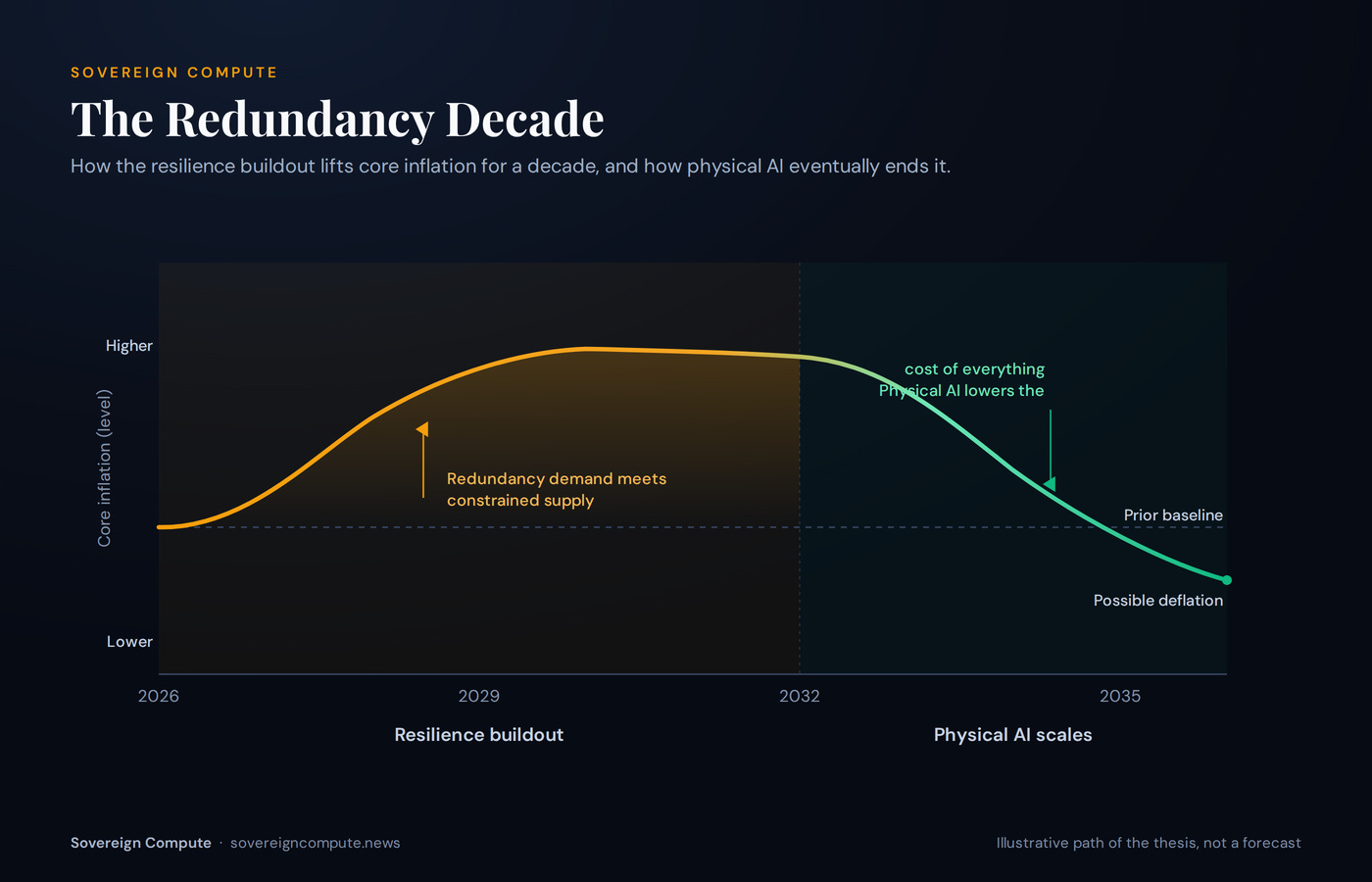
Core inflation steps up during the resilience buildout, then eases as physical AI scales. Illustrative path of the thesis.
Hardening and decentralising infrastructure means building much more than previous plans assumed: duplicate routes, ports, pipelines, new critical industries, distributed generation, data centers, microgrids, mobile and rapidly replaceable equipment, spare transformers and switchgear, and the software defences that guard all of it against cyber intrusion. That additional demand arrives on supply chains the AI and energy buildout has already stretched. Adding a large increment of new orders to a supply curve that has already become steeper pushes prices up broadly, and it does so persistently rather than as a single spike. This is core inflation stepping up to a higher level and holding there while the buildout runs.
Sustained higher inflation holds central bank policy rates and long-term bond yields up, and it does so when the global debt stock sits at record highs and governments have little room to absorb higher interest costs. And debt service competes with the security spending the moment requires.
The security response and the fiscal position pull against each other, and that tension is the defining macro feature of the decade. It also sharpens the question I set out in The Future of Money in the AI Exponential Age: who funds sovereign debt as its old anchors weaken.
Public budgets cannot carry this alone, which points to where the capital comes from. The template exists in energy. Facing grid queues stretching years, power they could not secure fast enough, and social turmoil, the AI labs stopped waiting for utilities and began financing generation directly. Microsoft signed a roughly $16 billion twenty-year agreement to restart the Three Mile Island reactor, Amazon put money into small modular reactors and a nuclear-anchored campus, and Meta contracted for several gigawatts of new nuclear capacity. Nvidia is now in talks to guarantee about $250 billion of the financing behind OpenAI’s planned Ohio campus, credit that lenders would not extend to the operator on its own.
Private capital is underwriting infrastructure that public institutions cannot deliver at speed. The resilience buildout will follow the same route: the companies whose assets are exposed, alongside infrastructure funds and insurers, will finance hardening and redundancy directly, because the state cannot fund all of it and cannot afford the disruption if it goes unbuilt, nor the social upheaval if it emits even more debt to finance it.
The same intelligence running inside those hardened data centers is the force that eventually lowers costs. As physical AI and robotics move into construction, manufacturing, logistics, and maintenance, they replace human labour across the activities that make redundancy expensive, and the price pressure that defined the buildout begins to reverse. In the framework of the money paper, this is the transition giving way to abundance: scarcity of safety drives prices up first, then abundance of intelligence pulls them down, possibly into deflation. A decade of higher inflation, then relief, with roughly ten years as the window.
Efficiency optimised for calm conditions no longer describes the world we live in, and that is being built. The next ten years reward redundancy and regional strength over globalization and lean design, distributed capacity over centralised scale, and balance sheets positioned for rates that stay higher for longer rather than a quick return to cheap money. The investment case sits in the equipment, the power, and the financing of resilience; the macro case sits in bonds and rates that hold higher than the last cycle taught people to expect. Building for a world that gets interrupted is the work, and its price is the inflation of the decade we live.
A note on independence: All opinions shared in this newsletter are my own and do not reflect the views of dmg events, ADIPEC, or any affiliated organizations. This is personal analysis, not institutional positioning.
Sources
• Damietta drone strike (Reuters/CNBC). https://www.cnbc.com/2026/07/30/egypt-drone-gas-ship-damietta-port-iran-war.html
• First attack on Egyptian soil (Euronews). https://www.euronews.com/2026/07/30/drone-hits-us-lng-vessel-at-damietta-in-first-attack-on-egyptian-soil
• Strait of Hormuz transit brief (Lloyd’s List Intelligence). https://www.lloydslistintelligence.com/resources/blog/strait-of-hormuz-brief-29-july-2026
• Hyperscalers financing nuclear power directly (Forbes). https://www.forbes.com/sites/kensilverstein/2026/07/26/the-ai-boom-is-making-nuclear-power-bankable-again/
• Nuclear-for-AI deal tracker (SMR Intel). https://smrintel.com/nuclear-data-center-deals/
• Nvidia–OpenAI $250B financing guarantee, in talks (CNBC). https://www.cnbc.com/2026/07/27/nvidia-and-openai-in-talks-for-up-to-250-billion-dollar-ai-backstop.html
• Power and interconnection rights entering the capital stack (Ropes & Gray). https://www.ropesgray.com/en/insights/alerts/2026/06/when-power-becomes-part-of-the-capital-stack
• The Future of Money in the AI Exponential Age (Sovereign Compute). https://open.substack.com/pub/ferrarivarese/p/the-future-of-money-in-the-ai-exponential