
The Future of Money in the AI Exponential Age
A Comprehensive Blueprint for the Structural Migration of Value and What Backs Money: From Today's Debt-Based Currencies to the Long-Term Rise of the Infrastructure-Based Coordination Protocol

Executive Summary
Open the Interactive Future of Money Notebook here.
You used money today and never once asked what it is or what stands behind it. Almost nobody does. I certainly didn't before studying economics at university. Yet, for the first time in fifty years, the answer to what money is - and the implications for how to prepare for that change and where to invest next, which I highlight in the closing chapter, Where This Leaves Capital - is about to change.
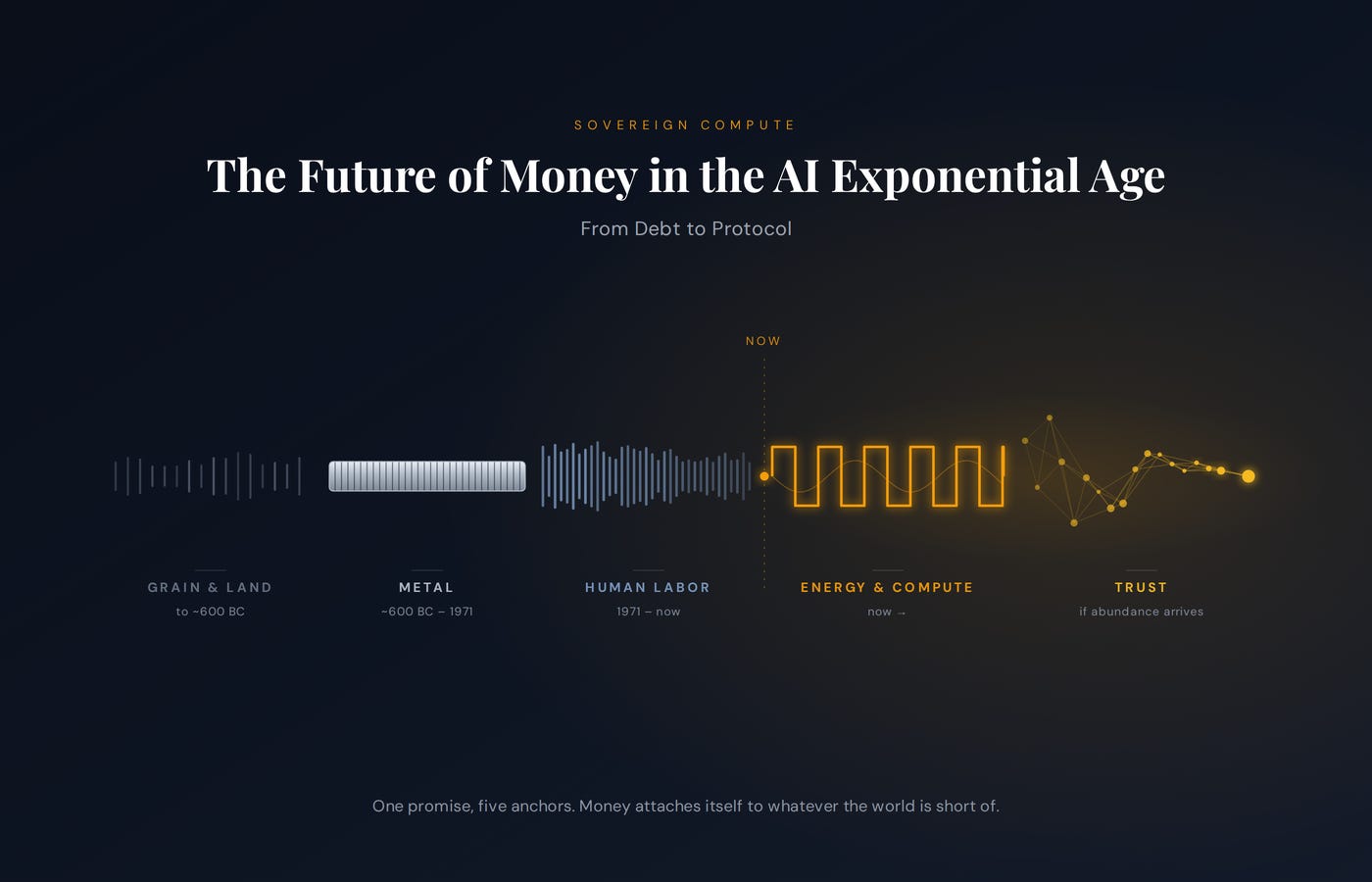
Money is a promise, and every promise needs something scarce behind it. Farming societies had grain. Empires had gold. Since 1971 the dollar has rested on something less visible and more fragile: human work. Currently, eighty-four cents of every dollar Washington collects comes from what people earn, which means the safest asset on earth, the US Treasury bond, is a claim on future paychecks.
Now machines are learning to do the work. Fast.
This paper is about what comes next. Money obviously does not disappear. It migrates, the way it always has, toward whatever the world is short of. Today that is electricity and computing power, the two inputs behind every act of machine intelligence. Both are already priced, hedged, and traded in dollars, and lenders are already changing what they will lend against, moving away from human wages and toward power contracts, permits, and grid connections. The structure of the next monetary system is being created while the raging debate is still about AI models.
Then comes the stranger part. If energy and intelligence become close to free, money stops being a claim on debt and starts to resemble a share in the world’s automated infrastructure: issued against measured hardware, physical capacity, spent by AI machines transacting thousands of times a second, governed by rules written into code rather than voted through parliaments. Political power follows the money, shifting from the right to tax what people earn to the right to set what the machines are permitted to do.
What follows is the map.
This paper comes with a companion notebook. It holds the full text, the charts, and the sources behind them, and it turns the material into something you can question rather than only read. Listen to the audio summary on your commute, work through the visual breakdown, then put your own questions to the argument: test a scenario, push back on a probability, or ask in the chat window what any of it means for your own sector. The voices in the audio are AI-generated. The analysis is mine.
Open the Interactive Future of Money Notebook here.
The Future of Money in the AI Exponential Age
Every dollar is a promise. For more than two centuries, the stability of that promise, that a dollar will be accepted in the next transaction and that it holds its value against other currencies, was backed by structural economic scarcities: first by precious metal, and since 1971, by the strength of the US economy: its productive capacity, its ability to raise taxes, and ultimately the military power that underpins confidence in the system.
Today, the global reserve currency, the United States Dollar, floats free of physical anchors, resting instead upon two profound institutional promises enacted over the past century: a claim on domestic economic output through taxation, and a global, energy-linked and perpetual structural demand for the currency. Artificial intelligence is breaking both foundations at an exponential cadence. As the primary engine of economic production shifts rapidly from human cognitive labor to automated, intelligent systems, money must fundamentally change what it represents.
This paper puts forward a structural rewrite of the future of money. It diagnoses the terminal erosion of the legacy fiat system, critiques the logical fallacies of early post-abundance models, and outlines the inevitable transition from debt-based currencies to a dual-layered execution architecture, culminating in the long-term rise of the Coordination Protocol.
Chapter 1: The Anchored Ledger and the Two Sovereign Promises
To track where money is moving, we must establish what money is at its most primitive level. As economic strategist Lynn Alden articulated (a view formalized in the academic literature by Narayana Kocherlakota’s “Money Is Memory,” 1998), money is fundamentally an informational ledger: a shared, immutable record of who owes what to whom (Alden, 2023). The physical artifacts, be they cowrie shells, gold coins, paper notes, or digital database entries, are simply the technologies deployed to protect the integrity of that record against manipulation.
This perspective also highlights an important principle that runs throughout this paper: money is not a fixed concept. Its defining function evolves with the technologies and institutions that sustain it. Each era’s money answers a different question, and this paper traces that evolution: from a ledger, to a claim anchored on the tax base, to a coordination protocol.
Historically, an honest ledger requires an anchor: an underlying resource so structurally scarce that no actor can counterfeit or inflate the record by creating it out of thin air. Throughout history, money has naturally anchored itself to whatever critical input the economy ran short of. Agrarian structures anchored wealth to grain and land acreage. Expanding global empires, facing a baseline deficit of international trust across vast physical distances, anchored their ledgers to gold, a substance governed by the strict laws of physical geology, or in Alden’s terms, a ledger kept natively by nature itself.
The current architecture of the global reserve currency, the United States Dollar, floats free of physical anchors, resting instead upon two profound institutional promises enacted over the past century:
The Domestic Labor Promise: The government asserts an unyielding claim on domestic economic output. In fiscal year 2025, the US Treasury collected approximately $5.2 trillion in federal receipts, with roughly 84 percent derived entirely from individual income and payroll taxes (US Treasury, 2025). The massive $37.6 trillion pool of outstanding Treasury debt - the bedrock risk-free asset underpinning global finance - is systematically serviced out of this structural flow. A government bond is, mechanically, a legal claim on human paychecks that have not yet been earned. The dollar maintains domestic utility because a population of a third of a billion people must continuously acquire dollars to satisfy their sovereign tax obligations. The mix of taxation is a political choice, and it has shifted before: tariffs once funded the federal government, and corporate taxes were once a far larger share. But two things make wages the load-bearing base today. They are 84 percent of receipts now, and labor is taxable at that scale precisely because workers cannot easily flee, whereas capital and code are mobile and jurisdiction-shop, so re-targeting the base onto them is structurally hard, not merely politically unpopular. Chapters 2 and 5 examine why the obvious alternatives fail and what replaces them. Taxes are the floor that makes refusal of the currency impossible; everyday network acceptance, the dollars you need for groceries, is the building that stands on that floor. Both channels drive demand, and the tax floor is what ultimately underwrites the rest.
The External Demand Promise (oil is its most visible instrument, not its entirety): Established via geopolitical agreement in 1974, Washington and Riyadh anchored the global dollar ledger to the physical energy economy. By ensuring that oil, the indispensable commodity driving all industrial advancement, was priced and invoiced strictly in dollars, the global financial system created a perpetual structural demand for the currency. Surpluses from this energy trade were then recycled directly back into US Treasury securities. Under this architecture, nations were forced to accumulate dollars regardless of their direct political alignment with the United States.
Many of the largest monetary disruptions of the past fifty years can be traced to the balancing or shifting of these two core promises. Artificial intelligence is now systematically undermining both simultaneously.
Chapter 2: The Fifth Turn and the Corporate/Robot Taxation Trap
The transition of the domestic promise follows a timeline dictated by advanced machine capability. Economists Anton Korinek and Donghyun Suh demonstrated through rigorous macroeconomic modeling that while human wages rise during the early phases of automation, they face a sharp terminal contraction as models approach the full frontier of human cognitive capability (NBER, 2024). When the marginal cost of intelligence scales downward exponentially, human labor ceases to be the scarce constraint of the production loop.
Read against the structural reality of the modern state, this creates a profound fiscal paradox. If individual wages carry a shrinking percentage of total economic throughput, the 84% tax base anchoring the global reserve currency begins to evaporate. The risk-free asset is exposed as a claim on an asset class that is actively being automated out of existence.
Faced with this disappearing labor tax base, conventional economic policy frequently proposes a simple pivot: increase corporate profit taxes or implement a targeted ‘robot tax’ to close the fiscal deficit. However, this relies on a deeply flawed, legacy assumption, namely, that corporations in a hyper-automated economy will retain pricing power and nominal profit margins.
In a post-singularity abundance state, this assumption falls flat for reproducible and cognitive goods, whose marginal cost collapses toward zero. The collapse is not universal: raw materials, land, maintenance, and the return capital required to deploy remain real cost floors, and the monetary anchor migrates precisely onto those non-reproducible inputs, as Chapter 5 develops. When software intelligence and robotic physical labor can replicate goods at zero human cost, hyper-competition and open-source models inevitably drive consumer pricing down to the physical floor. A corporate automated factory might produce tens of millions of products daily, generating extraordinary real wealth (infinite output), but because its marginal cost is near zero, its nominal revenue and financial profits shrink to practically nothing. Taxing corporate income or cash flows yields near-zero yield when nominal cash velocity itself vanishes from corporate books. The state cannot fund its operations by taking a percentage of private financial transactions if the market economy has structurally deflated its own nominal cash flows out of existence.
There is a deeper reason the fiscal problem does not simply dissolve, and it answers the logical objection that if everything gets cheap the state no longer needs revenue. Government obligations are nominal and contractual: debt service and pensions are promised in fixed dollars. Collapsing nominal revenues against fixed nominal liabilities is not relief; it is Fisher’s debt-deflation, the crisis itself, even as the cost of providing services falls.
Concurrently, the international energy promise is shifting. The world’s most indispensable commodity is transitioning from raw hydrocarbons (oil) to manufactured intelligence (compute). Compute factories run on two fundamental physical inputs: electricity and specialized silicon arrays. While compute cannot serve as a liquid currency or a fixed reserve asset because it undergoes continuous, aggressive technological depreciation, it is rapidly becoming an anchor through invoicing, as evidenced by the announced launch of dollar-denominated GPU futures by major global derivatives exchanges like CME and ICE.
Two clarifications matter here. CME with Silicon Data announced these contracts on 12 May 2026 to launch later in the year, pending regulatory approval, and ICE followed; they are not yet live. Second, futures alone do not make a monetary anchor. Many commodities have futures and anchor nothing. A currency is anchored when the era’s binding constraint is invoiced and hedged in that currency, with the resulting surpluses recycled into its bonds, which is oil’s actual history. Wheat has futures but was never the binding constraint; compute is. To be precise on terms: to be money is to circulate as the unit; to back money is to be redeemable for it at a fixed rate; to anchor money is neither, it is to be the scarce constraint the currency is priced against.
A note on a common error in post-abundance thinking.
Many theoretical camps, ranging from positional economists (Hirsch, Korinek) arguing that wealth will split entirely into new scarcity like land in downtown Manhattan or priority positions in queues, to Web3 tokenomics architects asserting that universal fiat will fracture into specialized resource tokens (such as carbon absorption rights or data center permits), fall into a shared conceptual trap. They mistake highly valuable, illiquid physical assets, for functional currencies. An economy cannot operate on a hyper-fragmented, friction-heavy barter system of specialized utility vouchers. It fundamentally demands a hyper-liquid, standardized medium of exchange and a single automated unit of account to coordinate billions of agentic/machine transactions per second.
Chapter 3: The Short-to-Mid Term Transition: The Bifurcated Ledger (2026–2035)
Over the next decade, I foresee that the monetary system will resolve this tension by splitting into two distinct, parallel execution layers running on completely separate technical and legal rails: The Human Layer and the AI Machine Layer.
1. The Human Layer (The Capital & Consent Rail)
Humans will continue to operate within traditional sovereign fiat frameworks, but their direct interaction with the transactional ledger will be heavily mediated by AI agents. Money at this layer transforms from a direct spending mechanism into a protocol for credentialed consent and risk boundaries.
Mechanics: Transactions will be executed almost exclusively by AI agents through cryptographic mandate schemas. Rather than manually approving individual payments, human principals will sign cryptographic boundaries that restrict autonomous AI agents to specific spending policies (e.g., maximum daily caps, restricted merchant categories, and validated utility nodes).
Systemic Role: Human money becomes a defensive architecture designed to manage the risk of autonomous machine execution, focusing on policy compliance rather than rapid velocity.
2. The AI Machine Layer (The High-Frequency Agentic Rail)
Simultaneously, the vast majority of transactional volume will migrate to an autonomous, machine-to-machine (M2M) network. Traditional banking APIs, burdened by manual settlement windows and legacy clearing identity checks, are entirely incompatible with software systems optimizing resources in milliseconds.
Technical Infrastructure: The machine layer runs natively on ultra-fast layer-1/layer-2 blockchains and open programmable streaming rails (Ethereum, Solana, Sui, etc).
Operational Protocol: Value moves at internet speed as programmatic grease for the compute-energy nexus. When an autonomous agent encounters a localized data center processing bottleneck, it instantly discovers an alternative provider, negotiates a fraction-of-a-cent volume discount, verifies the transaction against its spending rules its owner set, and settles instantly using high-velocity stablecoins. It is worth answering a natural objection here: if the marginal cost of everything falls to zero, why would machines need a unit of account rather than a bare verification protocol. The answer is that average cost near zero and instantaneous capacity are different things. A resource can cost almost nothing to produce over a year and still be scarce at ten o’clock on a Tuesday morning, when everyone wants it at once. Electricity shows this today. On sunny, windy days power costs almost nothing to generate, and wholesale prices sometimes fall below zero. Yet electricity is priced by the minute, and those prices carry more weight each year, because the grid has to decide who gets power at the moment demand peaks. Prices are how a system rations what is scarce right now. The machine layer meters exactly that: the cost of being served this instant instead of waiting.
In the modern world, most people already live a primitive version of this. Mortgages, bills, and cards are paid automatically: we choose what, and the bank executes. The novelty is not automated execution, which already exists on legacy rails. It is bounded decision delegation. Agents will make choices we never individually see, discovering counterparties and transacting with strangers’ machines at fractional, instant, cryptographically-settled granularity that direct debits cannot reach. Today’s autopay runs on legacy banking rails without immediate settlement or infinitesimal transactions; the coming shift is an explosion of agent-to-agent interaction that has no human-automation analogue.
One clarification on the unit. During this transition, the machine layer settles in digital fiat, dollar stablecoins, so the rail is new while the unit of account stays sovereign. This is not a native machine currency; it is the dollar executing on a programmable rail.
3. The Hybrid Backing Architecture of the Transition
During this mid-term bifurcated state, we will witness a critical uncertainty in structural economic forecasting. Money in this phase is neither backed entirely by future unearned human labor, nor is it a fully automated monetary protocol. Instead, the monetary supply is supported by a friction-filled, volatile hybrid architecture, the historic handoff between the disappearing scarcities of the old industrial layout and the front-edge constraints of the automated compute stack.
The backing splits by execution layer according to specific operational mechanics:
Machine Layer Backing (Compute Invoicing & Infrastructure Collateral): In the high-frequency machine network, the circulating money is predominantly dollar stablecoins, and their redemption value rests where it does today, on the cash and short-term government debt their issuers hold. What changes in this phase is the source of demand for that money and the collateral standing behind the credit built on top of it. Demand comes from metering. The machine layer prices whatever it can measure as it is delivered: processing time, electricity, bandwidth, storage, data access, and inference sold by the token. Two of those sit beneath all the others. Bandwidth, storage, and inference each decompose into silicon and power, and the decomposition stops there, which makes compute and energy the irreducible inputs the whole structure is priced against. Physical hardware reports what it does, continuously and in a form machines can verify: accelerators report utilization, power draw, and memory bandwidth; power distribution units in each rack report kilowatt-hours; facility meters report cooling and water; and the meter at the grid connection records electricity delivered under a Power Purchase Agreement. Each reading is signed at the source, which is what allows a payment to be triggered by a measurement rather than by a person. An agent renting 400 GPU-seconds generates a signed usage record, that record becomes a price, and the wallet settles it in dollars inside the same request. International demand for the reserve currency stops depending on human societies buying barrels of oil and starts depending on autonomous networks that must hold digital dollars to buy processing capacity every second of the day. Collateral changes in parallel. Lenders have historically underwritten against a claim on future human tax receipts, most purely in the government bond. They now shift that underwriting toward the physical blocks of the compute economy: high-performance silicon, data center facilities, and the long-term power contracts that gate electricity. Telemetry (meaning equipment that automatically reports what it is doing, the way a race car streams engine data to the pit wall) is what makes this possible, because a lender can watch the machines earning in real time instead of waiting for a quarterly statement. The token holds its value because it remains the mandatory pricing script for the economy’s primary computational inputs, and the physical layer beneath it is now continuously audited.
Human Layer Backing (State/Sovereign Intervention & Capital Handoff): In the human layer, as individual wage revenues carry a rapidly shrinking percentage of total economic throughput, the sovereign promise adjusts its fiscal anchoring strategy. The domestic dollar is backed by expanding legal imposition and capital equity extraction. Because the state can no longer generate significant yields from wages, it modifies the legislative tax net to capture corporate market capitalization, equity pools, and automated consumer transactions. Crucially, stablecoin issuers become the largest structural buyers of traditional US Treasury debt. This creates a powerful symbiotic feedback loop: the machine economy’s operational reliance on stablecoin liquidity forces the accumulation of government paper, effectively artificial-ventilating the legacy state’s financial system even as the human labor base beneath it dissolves.
Chapter 4: The Post-Singularity Architecture: The Coordination Protocol
When the global economy fully crosses the singularity threshold, entering an era where the marginal cost of intelligence, automated robotics, and primary energy production approaches zero, the classical concept of currency completely dissolves. In the legacy financial system, every dollar, euro, or bond in circulation is an instrument of Debt. It is a sovereign IOU (a written or digital acknowledgment that one party owes something) backed by the government’s promise that it will tax the future wages of human creators and laborers to give that money its baseline worth.
But when automated systems eliminate the economic necessity of human toil, individual wages carry a shrinking percentage of total economic output. The state can no longer fund itself or back its currency by taxing human wages, because those jobs have been automated out of existence. The traditional debt-backing model experiences a terminal structural collapse.
Money must therefore mature into its final, ultimate form: The blockchain-based Coordination Protocol. In an economy of total generative abundance, money stops being a representation of what citizens owe to the state (Debt) and transforms into a direct, liquid ownership stake in the automated infrastructure of the planet (Equity).
The monetary anchor is no longer physical gold bars or printed government promises. It becomes the physical layout of civilization itself, represented by tokens that live on a shared blockchain. If you hold a protocol token, you hold a hardcoded, fractional piece of the world’s total operational capacity.
In the protocol architecture, we hold universal tokens that represent our fractional equity in the civilizational operating system. When we spend those tokens, when we purchase something, we are simply choosing how to exercise our ownership share at that exact millisecond.
Money drops the illusion of being an abstract measure of human labour and becomes the literal software ruleset that coordinates the physical world.
Systemic Mechanics of the Coordination Protocol: Programmatic Minting and Supply Mismatch
The protocol functions as an automated blockchain-based system engine that mints Resource Allocation Units (tokens) based on a strict, cryptographic hardcoded rule: token generation must directly reflect the live expansion of physical hardware, of infrastructure capacity. When telemetry sensors scan the global infrastructure network and detect newly deployed hardware, such as orbital computing nodes, new production plants, agricultural fields or clean-energy fusion fields, the firmware programmatically creates a corresponding supply of new tokens and streams them directly to citizens as a dividend. The dividend supplies general purchasing power for everything, including human-to-human services, the way gold-standard money once bought bread that had nothing to do with mining. However, systemic over-issuance (inflation) can still occur, arising from structural calculation mismatches rather than arbitrary printing. This imbalance happens through three distinct triggers:
Telemetry Lag: An unexpected physical bottleneck, hardware degradation, or environmental disruption can suddenly drop real-world capacity, leaving an excess of already-minted tokens chasing a diminished physical pool.
Congestive Latency Spikes: Millions of autonomous agents might simultaneously attempt to execute high-intensity tasks at the exact same millisecond. This creates localized traffic jams that the underlying physical fabric cannot scale instantly to meet, meaning too many tokens are chasing too few open processing channels.
Governance Bloat: A democratic human population might use their upgrade keys (more in the next chapter) to vote for a baseline dividend that is permanently set higher than what the automated infrastructure network can safely execute under normal operating parameters.
When these mismatches occur, the protocol corrects itself not through policy debates, but through the automated, algorithmic burning of excess tokens on the blockchain at the exact point of congestion. For instance, when autonomous agents aggressively bid to clear a bottleneck, the excess allocation units spent on that priority queue are permanently destroyed by the firmware, automatically returning the outstanding money supply into equilibrium with the physical capacity of the hardware.
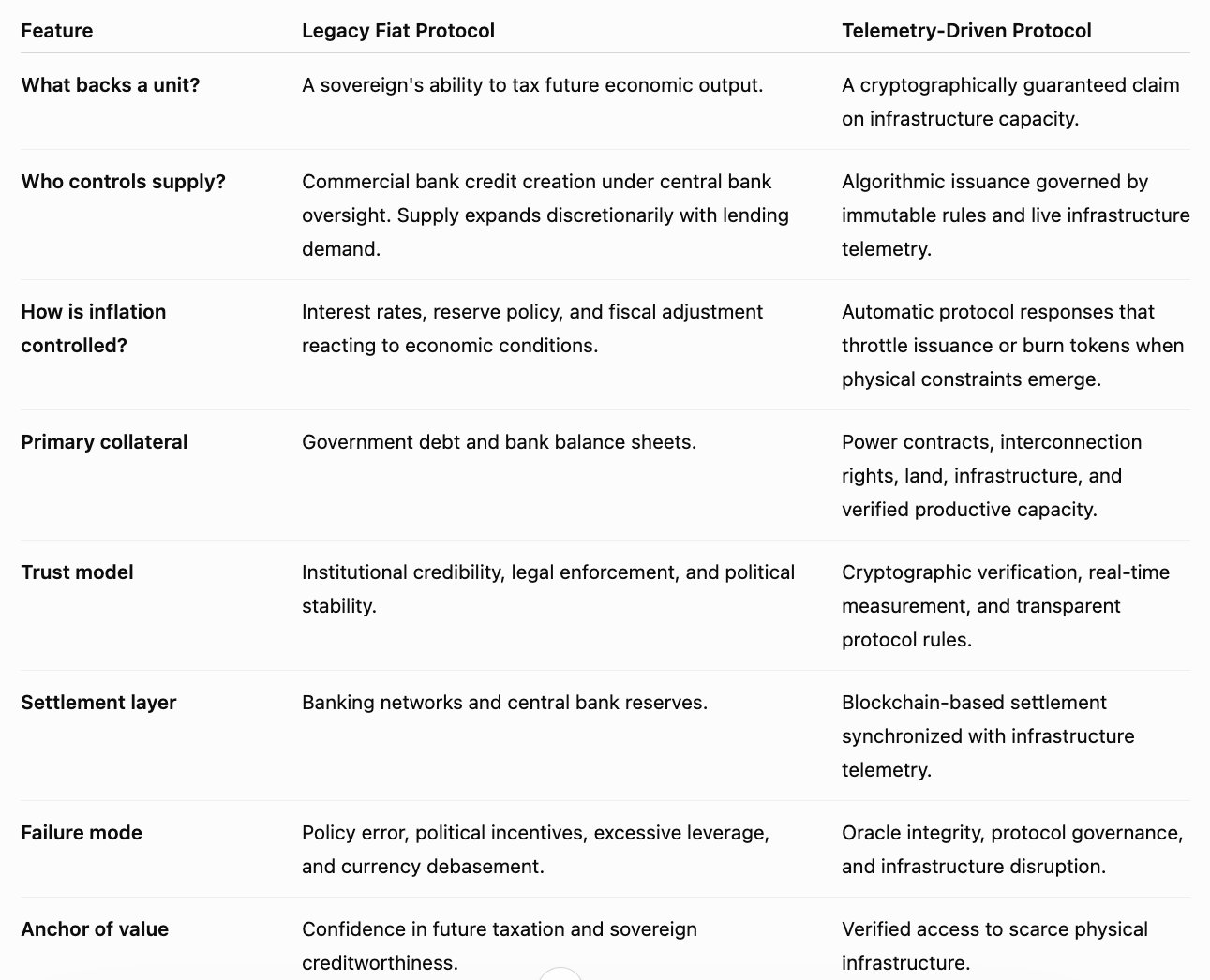
Table: Legacy Money vs. Telemetry-Driven Money
Chapter 5: How the State funds itself - The Post-Tax Sovereign and Architectural Governance
The transition to a post-singularity, abundance economy completely invalidates the historical concept of ‘funding’ the state. In the legacy fiat paradigm, a government must extract financial liquidity from private commerce via cash taxes to fund its operations and investments. When wage bases dry up and corporate nominal cash flows evaporate, this model collapses. The state can no longer act as a financial tollbooth.
Instead, the state fundamentally transforms from a tax collector into the Root Infrastructure Owner and Protocol Validator. Rather than extracting capital downstream from financial transactions, the sovereign maintains its existence and executes public policy by asserting native authority over the system’s ultimate physical and legal bottlenecks through three distinct mechanisms:
1. Primary Infrastructure Seigniorage
In full abundance, the state bypasses the intermediate requirement of gathering financial tokens altogether. Because the state maintains core sovereign ownership or ultimate regulatory claim over the foundational physical assets and infrastructure, it extracts value at the compilation level. When the protocol calculates the net real capacity of the global physical infrastructure, a hardcoded percentage (e.g., 15 percent) is routed automatically via system firmware directly to the ‘Sovereign Public Wallet’ to fuel civic services, automated defensive operations, and state computing requirements. The remaining 85 percent is programmatically streamed to the population as the baseline human Infrastructure Dividend.
2. The Georgist Pivot: Funding Through Spacial Scarcity
To resolve the fiscal collapse caused by vanishing human wages and zero-profit corporate structures, the system executes a “Georgist Pivot,” adapting the classical economic philosophy of Henry George to an automated ecosystem. Georgism dictates that while creators (or in our case AI agents) entirely own the wealth they generate through their own production, the value derived from natively scarce resources and physical space belongs fundamentally to the public. Because post-singularity automation and hyper-competition drive the nominal price of reproducible goods down to zero, the state abandons downstream taxation on income or transactional velocity. Instead, it generates sovereign funding by acting as the ultimate lessor of physical reality, capturing unearned economic rents by leasing out strictly finite spatial constraints, such as the exact geographical coordinates of a plot of land, orbital trajectory slots, and automated data hubs. Autonomous machine networks (and humans, when they choose to participate in the post singularity economy) must continuously bid against one another using native allocation units to secure these exclusive physical coordinates, funding public operations by taxing fixed positioning rather than infinite abundance.
3. Auctioning Manufactured Scarcity (The Permission Ledger)
When the marginal cost of physical fabrication hits zero, law and regulatory authorization become the binding inputs of macro-industrial expansion. The state, retaining its ultimate monopoly on systemic legitimacy, operates as the exclusive manufacturer of programmatic permission. To prevent catastrophic tragedy-of-the-commons failures within the physical stack, the state mints and auctions highly liquid, standardized certificates for strictly capped externalities. For instance, Grid Connection Slots (the physical authorization to link an array into the primary grid), Sink Allocations (the environmental right to discharge defined units of thermal waste into a local cooling basin), and Spectrum Waves. Autonomous networks are mandated by protocol rules to acquire these state-issued permissions to execute their models, ensuring continuous resource feedback to the sovereign ledger. This mechanism is deliberate, not a contradiction of the zero-cost claim. The auction price is a designed marginal cost: the mechanism by which the state re-inserts both a cost floor and a revenue stream into an otherwise costless economy. What it sells is manufactured positional scarcity, valuable precisely because others are excluded, which ties these certificates back to the precedence economy of the previous chapter.
The Shift to Architectural Governance
Consequently, human political agency shifts permanently from downstream fiscal redistribution to upstream architectural governance. Humans no longer clash over tax brackets, corporate deductions, or capital gains percentages; they vote on the blochchain firmware parameters of the global operating system ruleset via the Protocol Upgrade Vote. Human political power is preserved through root cryptographic validation keys, allowing the public to vote on two fundamental system parameters:
The Baseline Dividend Bracket: The collective determination of the absolute percentage of the global infrastructure that is structurally locked out of machine market optimization and reserved exclusively for equal distribution to human citizens via tokens.
Firmware Constraint Boundaries: Forcing absolute, hardcoded caps directly into the core execution firmware to ensure machine optimization swarms cannot for instance over-consume ecological or biological cooling systems, regardless of how highly those automated networks attempt to bid for them.
Chapter 6: Global Protocol Fragmentation and Arbitrage
A fundamental open question regarding the post-singularity transition is whether the global financial framework will converge toward a single, global, unified monetary architecture. The physics of infrastructure telemetry dictates that it will not. Because money in this advanced state is not an abstract social construct backed by human sovereign decrees, but rather a direct software claim on localized, physical hardware capacity, the global layout will permanently fracture along deep geopolitical borders. The post-singularity monetary landscape is best visualized not as an integrated global banking union, but through the modern technology paradigm of competing Layer-1 blockchain networks such as Ethereum and Solana, serving different states, regions or blocks in the world.
In this layout, the United States and China operate completely independent, non-uniform, parallel Layer-1 Coordination Protocols. Each network features its own native allocation token, structural priorities, and code definitions, engineered atop entirely separated physical sovereign infrastructure stacks. This resembles the familiar situation of two national currencies with an exchange rate between them. What is new is the delta: the mechanic is embedded directly in code, and settlement runs at machine speed and machine volume. A human or a machine buying a service priced in the other bloc pays on their own rail; an atomic swap converts value at the boundary; and the periodic net imbalance between the two systems is settled in gold or bitcoin, the asset both sides trust and neither issues.
The Mechanics of Exchange: From Forex to Telemetry Bridges
Despite this architectural fragmentation, these parallel systems remain dynamically exchangeable. What changes about foreign exchange is narrower than a replacement. Physical telemetry adds a new information set to price discovery, and settlement across the bridges gets faster and more automated. What does not change is that relative value between two systems still has to be determined, and a political trust premium persists: as the closing section argues, exchange value can dislocate the moment one stack stops recognizing the other. Foreign exchange today is the deepest market on earth, priced by rate differentials, trade balances, and capital flows, with central banks marginal actors in the majors, so the claim here is that the rails and the inputs evolve, not that manipulation is abolished.
In practical terms, when an autonomous machine swarm or a human principal inside the US stack requires the execution of an automated industrial process within a Chinese-governed hardware node, they do not buy alternative paper currency on an open exchange. Instead, automated cryptographic bridges instantly analyze live physical telemetry data from both networks, computing an objective exchange rate based strictly on infrastructure parity.
The cross-border exchange rate thus ceases to be an administrative or speculative variable. It transforms into an exact, objective mathematical reflection of global physical resource availability, network capacity bottlenecks, and live infrastructure utilization constraints. International commerce functions as an automated, friction-free resource-swapping mechanism operating at the speed of light.
The Conclusion of the Road
The post-singularity scenario stands on one foundation: trust. Which is also the best explanation of the strangest market signal of this decade. The central banks stockpiling thousands-year-old gold are buying an asset that yields nothing and computes nothing. They are buying the oldest trust instrument humanity owns, while the trust machinery of the next system is still under construction.
The New Meaning of Trust in a Code System
Even in a perfectly automated, code-driven monetary system, three layers of trust are still required to keep the ledger from collapsing:
Trust in Telemetry Integrity: A coordination protocol relies on data streaming from real-world physical infrastructure (sensors tracking heat dumps, fusion output, fiber-optic latency etc). The system must natively trust that this hardware hasn’t been physically compromised, spoofed, or militarily hijacked by a hostile state actor. If the telemetry data is faked, the code will programmatically mint the wrong currency supply.
Trust in Governance Boundaries: As mapped in Chapter 5, humans retain the cryptographic root keys to vote on system-firmware parameters (like the baseline human dividend bracket). The system requires an absolute baseline of political trust that the population won’t misuse their upgrade keys to break the system’s economic equilibrium for short-term gains.
The Shared Hallucination (Social Consent): Money is fundamentally a tool for coordination. Code can build a flawlessly honest scoreboard, but the scoreboard only works if everyone mutually agrees that the points matter. For instance, if a fragmented geopolitical crisis causes the Western stack to stop recognizing the validity of the Eastern stack’s tokens, the code on both sides remains perfectly unbroken, but the global exchange value vanishes instantly.
If the post-singularity system is the destination, we are currently living in the “Messy Middle”. The old monetary promises (fiat debt backed by human paychecks) are starting to fray due to AI-driven automation, but the new code-based execution protocols are still under active construction and deeply fragmented.
In this phase, central banks look at the board and see that the legacy dollar system is exposed to accelerating fiscal strains, while the upcoming machine economy is fracturing into competing, non-uniform regional networks. In this highly unstable transition phase, capital flees away from yield and toward absolute permanence. Central banks are stockpiling physical gold because it is the ultimate neutral ledger “kept by nature itself”.
Gold requires zero electricity to maintain its scarcity.
Gold cannot be digitally frozen, deleted, or blocked by a rival nation’s software updates.
Gold requires no geopolitical or technological alignment to hold value.
The global rush to gold is the soundest market signal available. It is sovereign powers buying an archaic, un-hackable trust insurance policy to protect their balance sheets while humanity builds the cryptographic code rails of the next monetary paradigm.
Where This Leaves Capital
This section describes categories implied by the analysis. It is not investment advice, not a recommendation, and takes no account of any individual’s circumstances. Readers should consult a licensed adviser before acting.
Readers who allocate capital will want the practical translation of this version of the future. The logic is the same one that runs through the paper: own what stays scarce across most versions of the story, rather than betting on any one of them.
The analysis points at categories rather than names, and it separates them by phase, because what is scarce during the transition is not always what stays scarce after it.
Through the transition, the key shortage is energy and compute, and in part, land. That favours the physical layer that generates and moves power, the neutral reserve assets both blocs hold because neither one issues them (gold, bitcoin), and the jurisdictions carrying energy and computing capacity on the same balance sheet (Gulf countries). It also favours two layers that take a toll on the traffic rather than betting on the hardware. The first is the pricing layer: the exchanges, benchmarks, and custody that clear the compute trade and earn their margin whichever chip generation wins. The second is the settlement layer, meaning the programmable payment rails (blockchains, ethereum in particular) and the issuers of the digital dollars that move across them, which earn on the float as machine commerce grows. Some long government bonds belong here too, as the hedge that pays in the branches where everything else struggles.
After the singularity, energy and compute stop being scarce and the shortage moves to what physics and law refuse to expand: Position and place (land). Permits, rights, and licences that gate what may be built. And verification, meaning proof that something is real, which is where the oldest trust assets end up. That last category is where the blockchain-based settlement machinery reappears in a different job, securing truth besides just moving payments, alongside the fixed-supply neutral assets that become attractive precisely when everything reproducible has fallen toward zero.
For long-term investments, the overlap between those two phases and asset lists is the particularly useful part.
Monitor the signals
For anyone who allocates capital or writes policy, the map reduces to three signals. Follow the collateral, because money re-anchors wherever lenders are willing to lend, and the mix tells you which way it is moving. Underwriting against power contracts, interconnection rights, infrastructure, land and permits is the durable re-anchoring, since those assets hold value for decades. Underwriting against GPUs is the fragile version, since the chips depreciate in about three years against loans written for much longer, and that gap is the fault line beneath the entire buildout. Watch the tax base, because the dollar’s domestic promise is written on the withholding line of every payslip, and the day a major economy legislates a serious land or infrastructure tax is the day the state begins shifting its weight onto a new foundation. And translate the eulogies: when someone announces the death of money, they are announcing the death of scarcity, which has survived every technology since fire. Money will do what it has always done, attaching itself to the newest shortage on terms set by whoever gets there first.