
While Critics Say Trump Breaks Alliances, Eleven Countries Just Built a US-led Tech Supply Chain Bloc
Pax Silica isn’t headline news. That’s exactly why it matters.

In December 2025, the U.S. State Department launched Pax Silica — a framework of nine countries (now expanded to eleven) committed to a coordinated AI supply chain spanning semiconductors, critical minerals, energy infrastructure, and compute capacity. The signatories: United States, Japan, South Korea, Australia, Israel, Singapore, the UK, the Netherlands, Qatar, Greece, and the UAE. India is potentially next.
The declaration is non-binding. There’s no enforcement mechanism. It formalized relationships that already existed. Which is precisely why mainstream media ignored it, and precisely why infrastructure investors should pay attention.
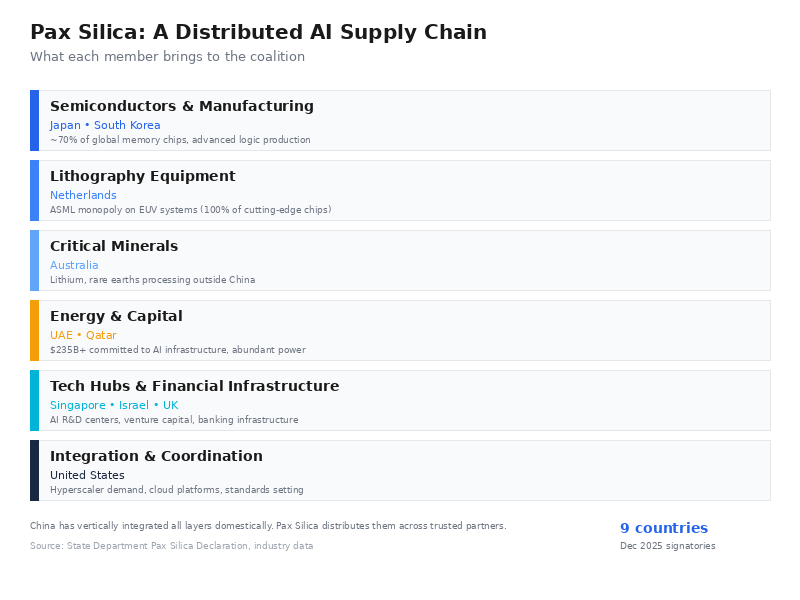
China has spent two decades vertically integrating its tech stack: domestic chip production (SMIC), rare earth monopolies — 70% of global mining, 90% of global refining, and 94% of permanent magnet manufacturing — captive energy supply, and hyperscale data center capacity, all under centralized coordination. The US and its allies cannot replicate that model individually. So they’re doing it collectively.
Pax Silica distributes strategic capabilities across trusted partners. Japan and South Korea anchor roughly 70% of global memory chip production and significant advanced logic capacity, and South Korea’s national semiconductor strategy explicitly targets becoming the world’s second-largest chip power. The Netherlands holds ASML’s monopoly on extreme ultraviolet lithography systems — the only technology capable of producing cutting-edge chips.
Notably, and unsurprisingly, the EU itself is not a signatory, and Under Secretary Helberg acknowledged “real material policy and philosophical differences” with Brussels.
The UK pulled in $23.6 billion in venture capital in 2025 — equal to France, Germany, the Netherlands, and Spain combined — positioning it as a financial engine for frontier tech. Australia provides rare earth processing outside Chinese control.
The Gulf commits sovereign capital at a scale no one else can match: the UAE alone has deployed $148 billion in AI investments since 2024, and the broader Gulf region has pledged over $2 trillion in AI, semiconductor, and infrastructure commitments.
Singapore and Israel anchor AI research hubs and venture financing.
Each country brings what others lack. None can compete with China’s vertical integration alone. Together, they cover the full stack — from mineral extraction through chip fabrication to data center deployment.
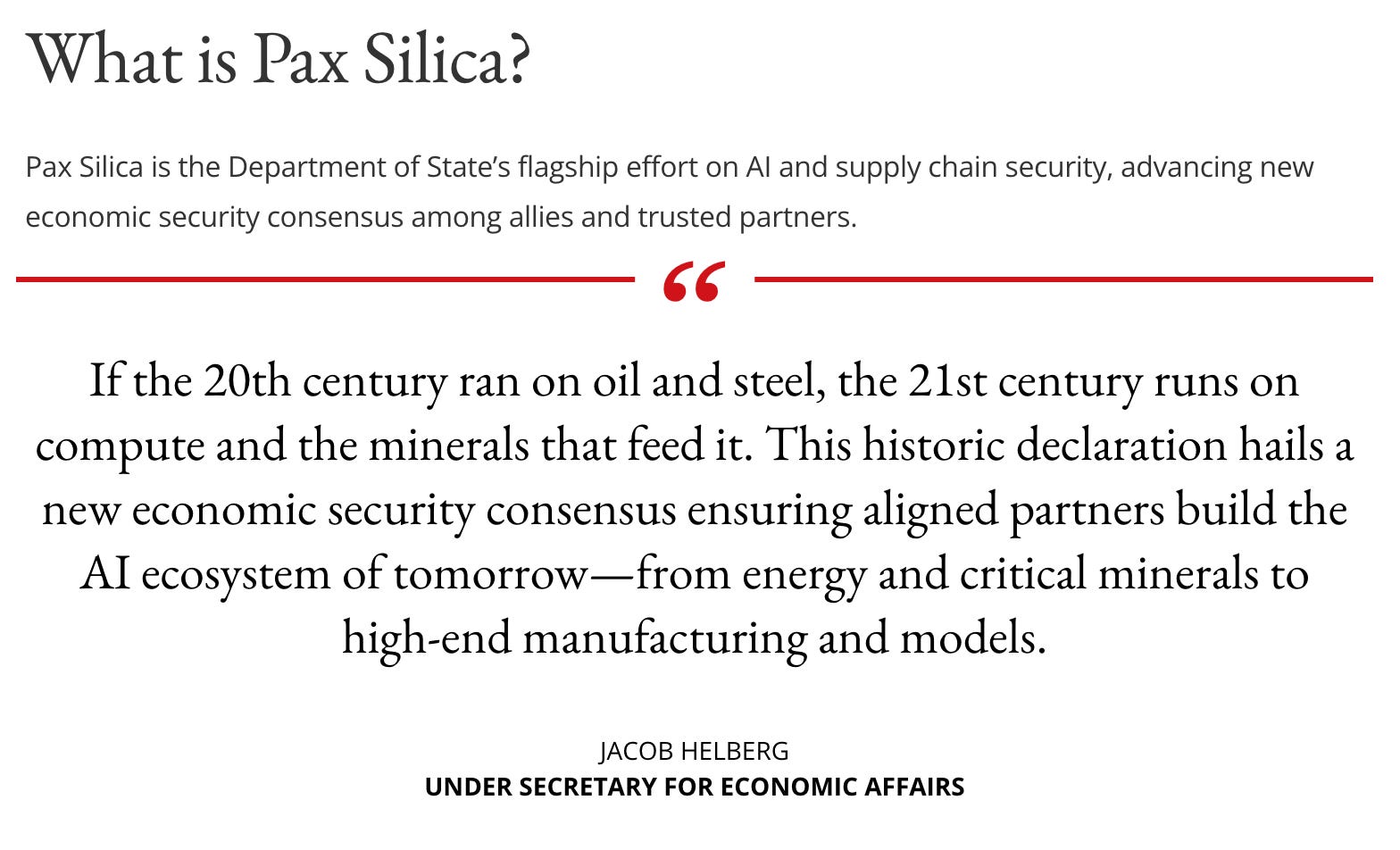
Under Secretary Jacob Helberg framed it bluntly: It’s about industrial policy coordinated across democratic governments to ensure no single authoritarian state controls the physical infrastructure of artificial intelligence.
The timing matters. The Trump administration faces persistent criticism that it’s dismantling alliances and accelerating deglobalization. Yet here’s a sophisticated multilateral framework coordinating hundreds of billions in investment across chips, energy, and critical minerals. Pax Silica rewards capability and alignment, not status or proximity.
The agreement landed with almost zero mainstream coverage because it doesn’t fit prevailing narratives. It’s not a dramatic rupture. It’s not protectionist theater. It’s eleven governments acknowledging that AI infrastructure is too strategic to leave uncoordinated and too complex for any single country to secure alone — even the United States.
Capital flows are reorganizing around trusted technology ecosystems. AI supply chains are fragmenting along geopolitical lines the same way energy access did during the Cold War. The blocs are forming now, during the buildout phase. And the logic of these blocs is simple: shared material interest in controlling the triangle of energy, compute, and power. The strategic question is straightforward: who is building relationships inside these emerging ecosystems, and who is still assuming global markets operate independently of alliance structures?
Pax Silica is the first alliance of the AI era. It won’t be the last.
Sources: