
Democracies Now Depend on Token Capital
AI frontier models are within reach of any government. The new evolution of democracies depends on them. Only the nations that own enough power, compute, and data can stay in the game.

A nation’s standing in the AI race is decided below the model. It rises when a state can run frontier capability on ample power, compute, and data it controls. Most cannot.
Every government can now get its hands on a frontier-grade model. Open weights put one within reach of any state that wants it. The contest that now sorts competitive nations from dependent ones is whether a state can run frontier AI as its own, on its own compute, its own power, its own data, under its own control. Most cannot. And that gap is widening.
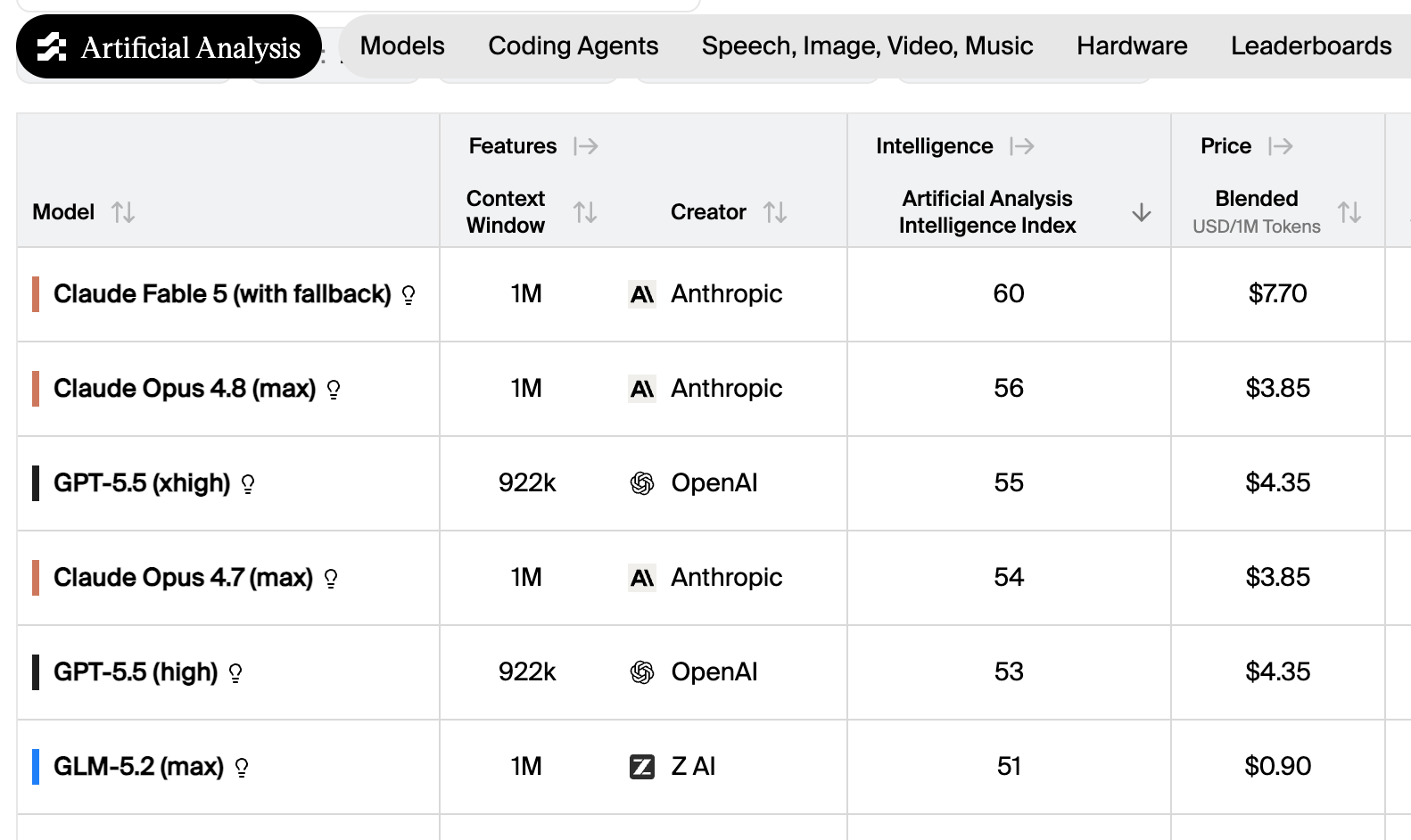
Open weights became a working default in 2026. The strongest open model, which is Chinese, now ranks fourth overall on the Artificial Analysis intelligence index, with only two proprietary systems above it that anyone can actually call after the US ban, and it reaches that level at a fraction of their price. On real-world task scores, it runs on par with the American frontier model most enterprises use, and within a few points of the leaders on coding and reasoning. When a capability that once cost a fortune runs for the price of the electricity behind it, its worth as a product falls sharply toward that floor.
Still, full commoditization arrives only when enough tier-one open models exist that no single vendor can lock a nation in, so it can switch the day a model closes or disappears, and when moving between them is painless, enabling a nation to carry its own work across without loss.
That specific work is the “loop”: the live, self-improving system a country builds on top of a base model. It’s the magic formula defining a country, the thing that turns its own data and experience into capability that sharpens the more it is used. And portability is the test. If switching means starting over, the model still owns the nation. The day the switch is clean, the model becomes a commodity, and the advantage moves somewhere else.
So the question is, can a nation move its loop to a new model today? Mostly yes. The valuable material a country builds up, its records, the history of how people used the system, its own tests for what counts as a good answer (in a democracy and elsewhere), and its store of national knowledge, does not belong to any one model. It sits in the country’s own hands and can be reused, if it’s been collected. What does not carry over is the expensive training of the model itself, because training done on top of one model cannot simply be pasted onto another. Instead, the country rebuilds that skill on the new model, feeding in the same records it kept and checking the result against its own tests until it matches.
How hard is that retraining? It’s expensive, though it is routine engineering rather than fresh invention, closer to repaving a road than designing the car. The effort grows with how much a country had customized: a light touch is quick, while years of deep tuning and carefully fitted behavior take time to redo and re-test. The winning nations have been customizing their models heavily, with the cost of retraining equal to computing power and skilled people. So the difficulty does not close the door on portability, but puts a steep price on it. A country with the data, the engineers, and the compute can switch whenever it needs to. A country short of any one of those is stuck.
So if the model itself is becoming a commodity, the next question is where sovereign advantage goes instead. That is what my Trust-Intelligence-Power framework (TIP) was built to answer. The interactive TIP triangle reads any sovereign strategy down three layers. Trust is who controls the rules, the data, and the alliances that decide whether you can even get the parts. Intelligence is who controls the models, the data, and the talent. Power is who controls the physical base: the grid, the firm electricity, the chips, the capital, the security of the buildings themselves. The three do not trade against each other. Strength in one cannot cover a hole in another, and the hole is where sovereignty breaks.
When grafting the commoditization question into the interactive TIP triangle, the answer is immediate. When the model goes free, Intelligence loses the scarcity that made it a moat, and advantage shifts to the layers that remain scarce: Power, and the parts of Trust and Intelligence that cannot be downloaded. The frontier labs feel it already and are remaking themselves into infrastructure and application companies. The prize has moved from the weights to everything the weights still need.
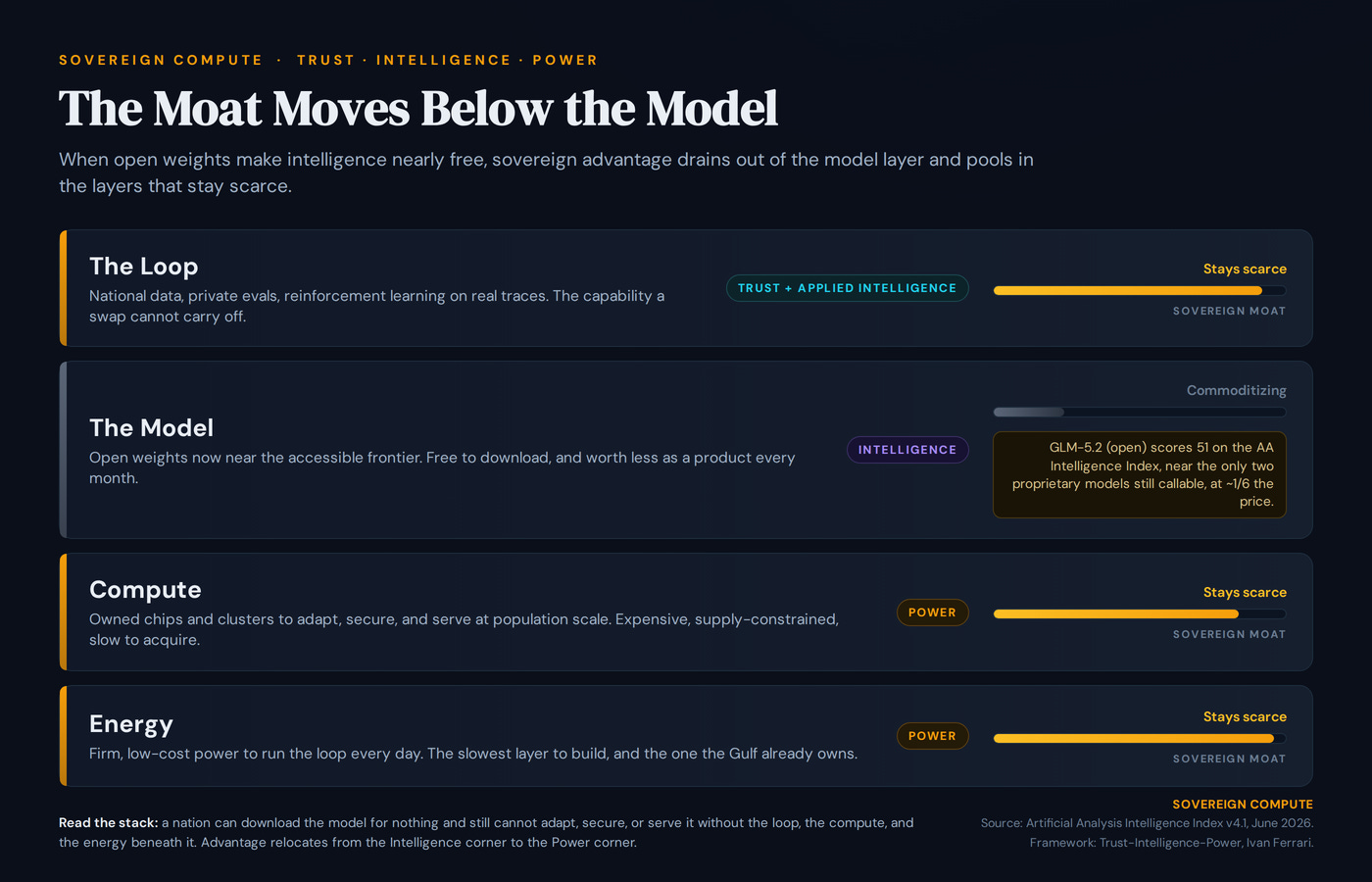
The moat moves. Advantage relocates from the Intelligence corner of the framework to the Power corner.
For nations, that shift produces an inversion: A government can download a frontier model for nothing, but it still cannot adapt it, secure it, or serve it to millions of citizens without chips, firm power, and capital it may not have. The gap drops to the layer that takes the longest to build and costs the most to own.
That reading is bullish for the Gulf
Saudi Arabia and the UAE have put serious sovereign capital behind a single idea: turn their cheapest asset, firm low-cost energy, into compute at scale. HUMAIN, the Stargate campus rising in Abu Dhabi, and partnerships with the largest American players carry that bet, and in a world where the model commoditizes, it is the correctly placed one. The scarce input is shifting toward the layer the Gulf can supply in abundance, and the imported-Intelligence dependency my framework scores as the region’s fragility shrinks as the models (closed included) go cheap.
It does not vanish, though. Two dependencies remain, and both sit one layer below the model. The first is capital, which the Gulf has in depth. The second is the compute itself: the advanced chips still come from the United States, and they arrive by conditioned export license rather than as of right. Saudi Arabia and the UAE are the only two states outside the top US tier cleared to buy Nvidia’s leading Blackwell parts, under security and reporting terms that Washington monitors on an ongoing basis. And at the very top of the AI reasoning curve, the hardest work still tends to run on closed American models, rather than on systems the region owns. So commoditization vindicates the energy bet and narrows the model dependency, while moving what remains of it onto the chip and the export relationship the Gulf has worked to secure.
The Harder Case
AI frontier access is being gated at the source, by the governments that produce it.
This month the United States pulled one lab's most capable models offline worldwide under an export order, and asked another to stagger its newest release to a handful of government-approved customers, one approval at a time, under a new executive order that sets a classified bar for the most capable models.
The open frontier, meanwhile, stays concentrated in a few labs, much of it Chinese and already contested over intellectual property and trust. So a nation leaning on the best closed models can have them rationed in Washington, and a nation leaning on the best open ones depends on a supply that may re-price or re-close. Either way, the base layer is borrowed. The nations that own the loop and the energy beneath it carry on, because the loop transfers to whatever model remains and the energy is theirs regardless.
Then comes the part that decides whether democracies can sustain any of this.
Nadella’s recent warning to firms was that if a handful of models capture most of the value, the political economy will not tolerate it, much as an earlier wave of globalization hollowed out industrial regions while national totals still looked healthy. Inside a company, that is a question of competitiveness. Inside a democracy, it becomes a question of consent. The evidence already sat in my “Three Models” piece: the spreading data-center backlash, the moratorium proposals, the climbing residential power bills, the local recall campaigns against approved projects.
So the same commoditization cuts two ways at once. It frees a nation from depending on anyone else’s model, but it concentrates the real value in whoever owns the energy and the compute, while straining the consent a democracy needs to build them. Owning a model is the cheap part, and on its own it is now close to worthless. Sovereignty is the loop, the loop runs on power, and a democracy has to share the proceeds to keep the right to build the thing that produces them. For an investor or a minister, three questions now settle the matter: do you own a loop, do you own the power and compute beneath it, and are you spreading the gains fast enough to sustain it.
A note on independence: All opinions shared in this newsletter are my own and do not reflect the views of dmg events, ADIPEC, or any affiliated organizations. This is personal analysis, not institutional positioning.
Great article! I will mention it and include a link to my Geek Weekend Digest on Saturday: https://frankdasilva.substack.com/s/weekend-digest
Additional context, from my Notes:
https://substack.com/@ivanferrari/note/c-286546496?r=1kaws&utm_source=notes-share-action&utm_medium=web