
THE AFRICA AI ARBITRAGE
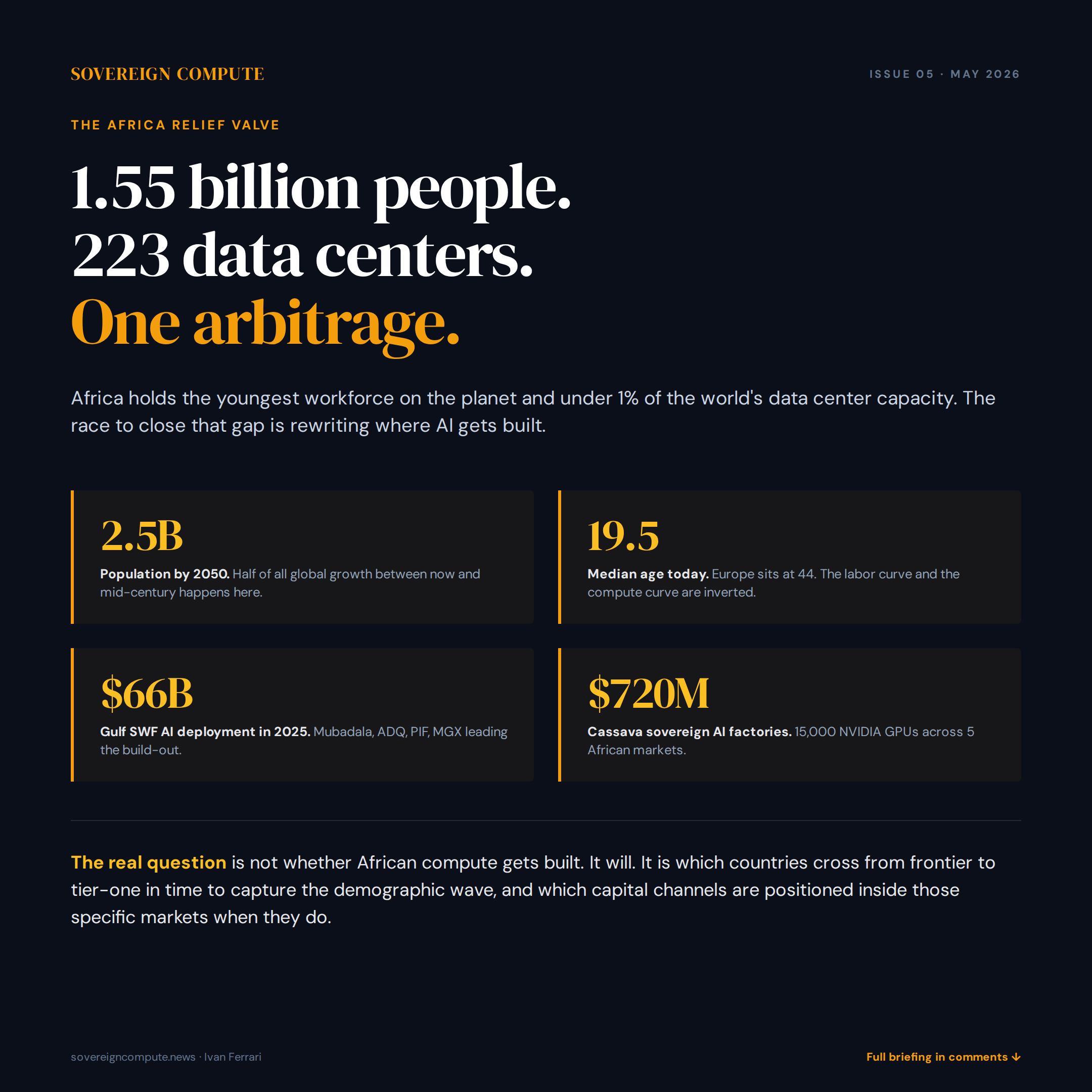
The continent that holds 25% of humanity by 2050 still hosts under 1% of the world's data center capacity. The race to close that gap is rewriting where AI gets built.

In 2050, one in four humans will be African. The continent’s median age today is 19.5. Europe’s is 44. The mismatch between where the population is heading and where the compute lives is the single largest infrastructure arbitrage of the next two decades.
Africa today has 1.55 billion people. By 2050 it will have 2.5 billion, according to the UN Population Division’s 2024 World Population Prospects. That is half of all global population growth between now and mid-century, concentrated on a continent currently served by 223 data centers across 38 countries (under 0.02% of the world total). Per capita compute capacity sits below 1 MW per million people. The Americas have 88.5 MW per million. Europe has 73.9. The five largest African markets combined operate around 400 MW of installed capacity, roughly half of what France alone runs.
Africa is not a country and the data makes that clear in striking ways. South Africa hosts 56 data centers, roughly 41% of the continent’s total alongside Kenya (19) and Nigeria (17). Morocco dominates the upcoming pipeline with 35-60% of planned new power capacity. Ethiopia has 1 facility. Gabon has 1. The Democratic Republic of Congo, projected to add nearly 200 million people by 2050, has effectively no commercial AI infrastructure today. The demographic dispersion is equally wide. Niger grows at 3.7% per year with a fertility rate above 6, doubling its population in under twenty years. Tunisia, Mauritius, and Cabo Verde are below replacement, the same demographic profile as Italy. Egypt is slowing toward 1.57% annual growth thanks to a national family planning campaign. Treating the continent as one market is the first error any infrastructure investor makes.
Three capital channels are racing to position inside this asymmetry, each with different motives.
Gulf sovereign wealth is treating Africa as a post-oil hedge with geopolitical upside. Mubadala, ADQ, PIF, and MGX deployed $66 billion into AI and digital infrastructure in 2025. The Microsoft-G42 geothermal campus at Olkaria, Kenya, anchors East Africa with an initial 100 MW phase scaling toward 1 GW; the first build is explicitly sized for inference and training of Swahili and East African language models, not generic cloud storage. Khazna operates into Egypt through the Benya Group. ADQ’s $35 billion Ras al-Hikma deal sets the template: sovereign capital deployed at a speed Western development finance cannot match, US technology alignment baked in at the chip layer.
China is running the Digital Silk Road playbook with a decade of head-start on physical infrastructure. Huawei equipment runs roughly 70% of African 4G networks. Its Cairo cloud region (the first in Northern Africa) grew 140% in year one and serves 28 African countries. Senegal’s national data center, hosting government data, was built by Huawei on a $79 million Chinese government loan and modeled on Beijing’s data governance architecture. Beijing provides more financing for African ICT than all multilateral agencies and Western democracies combined.
The third channel is African capital. Strive Masiyiwa’s Cassava Technologies committed $720 million to five sovereign AI factories across South Africa, Nigeria, Kenya, Egypt, and Morocco, with 15,000 NVIDIA GPUs running on Cassava’s own 110,000-km fiber backbone. The Johannesburg facility is reportedly 90% pre-booked. Liquid Intelligent raised $605 million in March 2026. Stanlib (Standard Bank’s asset arm) is acquiring a stake in Africa Data Centres. Nxtra (Bharti Airtel) opened a 38 MW hyperscale facility in Lagos. Teraco crossed 200 MW in Johannesburg. African capital is showing up at hyperscale for the first time, and it is using NVIDIA silicon, not Huawei.
Power decides where the campuses land, and the answer differs by country. Kenya’s grid is over 60% renewable, with the Olkaria geothermal field supplying half the country, which is why every East Africa hyperscale project routes there. Ethiopia is essentially all hydro, anchored on the Grand Ethiopian Renaissance Dam. Egypt is building the El-Dabaa nuclear plant with Rosatom and pairing it with gas, positioning the Suez corridor as a Europe-Africa-Asia hub. Morocco combines abundant solar with the planned Morocco-UK power interconnector to Europe. Nigeria has gas in abundance and a grid that delivers four hours of power per day on average, forcing operators to keep tens of thousands of liters of diesel on site. South Africa has Eskom load-shedding and the only mature electricity wheeling regime on the continent, which is why new projects there cluster around Northern Cape solar.
The bear case is real and worth stating plainly. UNCTAD reports African FDI fell 42% in the first half of 2025. Few countries have regulatory frameworks for long-term power purchase agreements. Microsoft-G42 Olkaria has not broken ground 18 months after announcement, with reports suggesting equity stakes between G42, Microsoft, and Kenyan state entities are still being negotiated. Chinese-built data sovereignty is a second layer of risk: the data is physically Kenyan, Egyptian, or Senegalese, but the architecture above it stays in Beijing. Modeling a smooth ramp to 2 GW by 2030 misprices both the political and the electrical risk.
There is one variable that analyses tend to leave out. By 2050 the working-age population (20-64) shrinks by 49 million in Europe, 195 million in China, 22 million in Russia, and 20 million in Japan. Sub-Saharan Africa’s working-age cohort triples to roughly 1.3 billion, almost twice the combined total of all high-income countries. If longevity science delivers anything close to what Sinclair, Kurzweil, and de Grey are projecting for the 2030s, the dependent population in advanced economies grows on top of a working population that is already shrinking. Compute demand in those economies rises, but the workers who build, train, and operate AI systems will increasingly need to come from somewhere else. Africa is the only large region where labor supply and power supply both grow.
The infrastructure decisions being made now (where the cables land, which governments get hyperscale partnerships, which power source anchors which campus) will determine who serves that demand and who collects the rent on it for the next forty years. The question is not whether African compute gets built. It will. The question is which countries cross the threshold from frontier to tier-one in time to capture the demographic wave, and which capital channels are positioned inside those specific markets when they do.
Sources
• UN Population Division, World Population Prospects 2024 Revision (medium-fertility variant)
• UN Economic Commission for Africa, “As Africa’s Population Crosses 1.5 Billion,” July 2025
• European Commission, “Developments and Forecasts of Increasing Demographic Imbalances”
• McKinsey Global Institute, “Dependency and Depopulation,” January 2025
• Institute for Health Metrics and Evaluation (IHME), Global Burden of Disease Study 2021, The Lancet
• World Government Summit 2026, David Sinclair remarks on aging-reversal trials
• African Energy Chamber, State of African Energy 2026 Outlook
• Mordor Intelligence, Africa Data Center Market Outlook, January 2026
• McKinsey, “Africa’s data center demand set to triple by 2030”
• ISS African Futures, “Data centre investments are a gamble for Africa,” 2025
• Microsoft / G42, $1B Olkaria Kenya geothermal campus announcement
• Cassava Technologies, $720M Sovereign AI Cloud announcement
• Billionaires Africa, Liquid Intelligent $605M recapitalization, March 2, 2026
• CNAS, “Countering the Digital Silk Road: Kenya,” 2025
• SWP Berlin, “Sovereign Wealth Funds and Foreign Policy,” February 2026
• A&O Shearman, “Sovereign wealth funds boost Middle East M&A growth,” January 2026
• CFR, China Digital Silk Road tracker
A note on independence: All opinions shared in this newsletter are my own and do not reflect the views of dmg events, ADIPEC, or any affiliated organizations. This is personal analysis, not institutional positioning.