
HYPERSCALERS ARE THE NEW FISCAL BUFFER
How hyperscaler balance sheets became the US macro-stabilizer, and why the Gulf's public capital stack is the credible backup

Five US hyperscaler balance sheets now carry capex equal to 2% of US GDP. Sovereigns carry the rest. In a multipolar system with thinner public budgets, the Gulf's public capital stack is building the redundancy needed.
At the IMF–World Bank Spring Meetings in Washington on April 15, Kristalina Georgieva warned that most countries are “less prepared to respond to a major economic downturn” than they were a decade ago. The April Fiscal Monitor backs her: global interest payments have climbed from roughly 2% to nearly 3% of GDP in four years, public debt sits at 94% of world GDP, and primary balances in most large economies are now below the level needed to stabilize that debt. Fiscal consolidation space has narrowed across the G20 in parallel, not sequentially. The policy toolkit most finance ministries brought to Washington is smaller than the one they used in 2020.
The missing buffer has a private substitute. Apollo’s Torsten Slok estimates 2026 hyperscaler capex at $646 billion, which is approximately 2% of US GDP, and larger than the combined 2025 defense budgets of Germany, France, the UK, Japan, Italy and Canada. Pantheon Macroeconomics attributes nearly one-third of Q4 2025 US GDP growth to AI-linked capex plus the wealth effect from tech equity gains. Apollo’s own measurement of real private fixed investment shows corporate capex outside AI at essentially zero growth. A fair question is whether AI capex is stabilizing US growth or crowding out the rest of it; either way, the concentration itself is the fragility, because the growth contribution now depends on the investment plans of five companies.
Sources: Apollo 2026 Outlook (Dec 2025); Apollo “How Much Is $646 Billion?” (Feb 22, 2026); Pantheon Macroeconomics via Fortune (Feb 26, 2026); IMF Fiscal Monitor Press Briefing and WEO (Apr 14–15, 2026).
That concentration has strategic-autonomy consequences the fiscal framing obscures. When Amazon, Microsoft, Google, Meta and Oracle are financing infrastructure at the scale the US Treasury used to fund, the United States has outsourced a core growth engine, and the physical stack of its AI capability, to five CEOs and the private-credit vehicles sitting behind them. I examined that single-provider pattern across cloud, models and launch in Three Dependencies, One Stack: the Anthropic FASCSA designation, the AWS strikes in the UAE and Bahrain, and SpaceX’s role in US military launch. The fiscal architecture now underwriting US growth sits on the same architecture. Monetary sovereignty, growth sovereignty, AI sovereignty and strategic autonomy have collapsed into one operational question: which balance sheets will still be able to build in 2028?
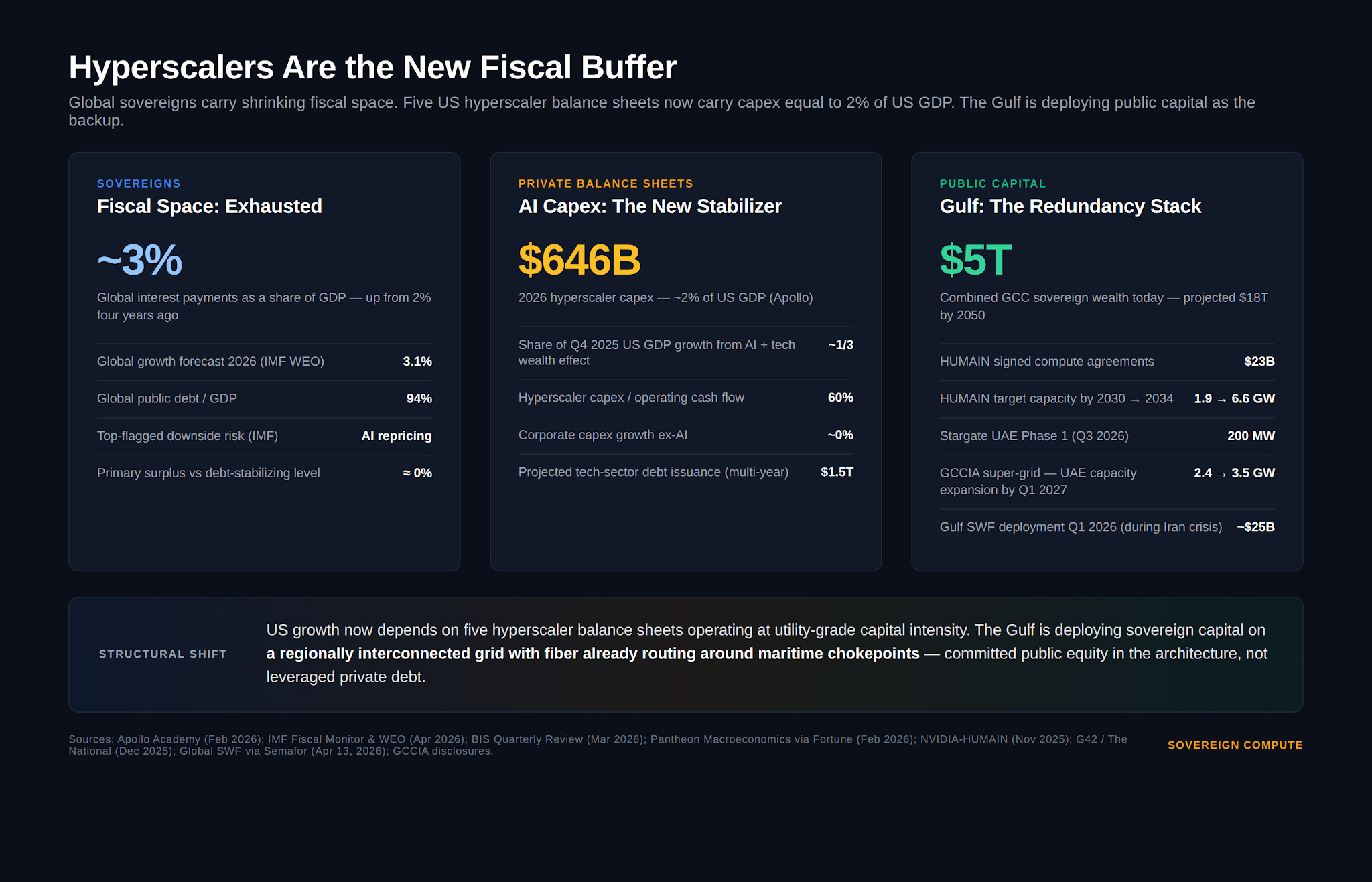
Three layers of the same question: public fiscal space, US private AI capex, and Gulf public capital, measured on the same axis of who can still deploy at scale.
The financing is already moving off the hyperscaler balance sheet
Hyperscaler capex intensity has already passed levels associated with regulated utilities rather than software businesses. Across Amazon, Google, Microsoft, Meta and Oracle, capex now absorbs approximately 60% of operating cash flow. Companies that invest like utilities tend, over time, to trade on utility-like multiples; a re-rating of AI equities toward that baseline is the specific mechanism by which the IMF’s flagged “AI repricing” would move from a tail risk to a valuation event. The bridge between operating cash flow and stated capex plans is already being built outside the hyperscaler balance sheet. Meta’s $30 billion Hyperion data center sits in a special-purpose vehicle, Beignet Investor, with $27 billion of debt from Pimco, BlackRock and Apollo and $3 billion of Blue Owl equity, which is debt that does not appear on Meta’s accounts. Oracle has structured roughly $38 billion of comparable financing for Stargate sites in Texas, Wisconsin and New Mexico; Pimco added a $14 billion commitment to Oracle’s Saline, Michigan campus on April 7. The BIS catalogued the shift in its March Quarterly Review. Morgan Stanley and JP Morgan project $1.5 trillion in new tech-sector debt issuance over the coming years, arriving as global sovereign interest payments reach nearly 3% of GDP. That is a margin pincer: rising capex against rising cost of capital. The Atlantic Council GeoTech Center has argued that financing itself is part of the AI infrastructure stack. The 2026 capex cycle is the direct evidence.
Sources: Apollo 2026 Outlook; BIS Quarterly Review (Mar 16, 2026); Financial Times reporting on SPV structures (Dec 2025); Bloomberg on Pimco-Oracle financing (Apr 7, 2026); Mellon Investments on AI debt issuance (Dec 2025).
The Gulf is deploying public capital on interconnected infrastructure
George Friedman’s recent essay locates the next emerging global industrial power in Latin America, dismissing the Middle East and Africa as “regions, not nations” too burdened by conflict to qualify. The empirical record in the Gulf disagrees. The GCC Interconnection Authority has operated a unified 400 kV super-grid since 2009, spanning roughly 1,200 kilometers of overhead lines and submarine cables across Saudi Arabia, the UAE, Qatar, Kuwait, Bahrain and Oman. GCCIA reports it has prevented more than 1,300 potential outages since commissioning. A $205.5 million expansion will raise UAE–GCCIA transmission capacity from 2,400 MW to 3,500 MW by Q1 2027. A direct Oman–GCCIA interconnection, the Ibri and Baynonah substations, is under construction.
The grid also carries OPGW fiber-optic cables along its rights-of-way, creating a terrestrial data corridor that bypasses Red Sea and Bab-el-Mandeb subsea chokepoints. For infrastructure investors and policymakers pricing subsea cable risk after repeated cuts in the Red Sea and Baltic, fiber on desert-grid towers carries a measurable financial return priced into every cross-border data flow that routes through it. The configuration converts physical redundancy into expected yield.
Sources: GCCIA official network disclosures; GCCIA “Our Plans” — Direct Oman Interconnection and UAE Expansion projects.
On that grid, sovereign capital is being deployed directly. HUMAIN, the PIF subsidiary, has $23 billion of signed agreements with NVIDIA, AMD, AWS and Qualcomm; a $10 billion joint venture with AMD targets 500 MW of capacity; its roadmap commits to 1.9 GW by 2030 and 6.6 GW by 2034 on a $77 billion plan. G42’s Stargate UAE, a Khazna–OpenAI–Oracle–NVIDIA–Cisco–SoftBank consortium inside the 5 GW UAE–US AI Campus in Abu Dhabi, delivers its first 200 MW in Q3 2026. Gulf SWFs deployed approximately $25 billion of new investments in Q1 2026, per Global SWF data reported by Semafor, despite running this pace through an active regional conflict. Combined Gulf sovereign wealth stands at approximately $5 trillion today, with projections to $18 trillion by 2050. The financing model is public equity committed directly into infrastructure, not private debt structured through SPVs, which gives it a different risk profile to the shock channels that could hit the US stack.
Sources: NVIDIA-HUMAIN press release (Nov 19, 2025); Arab News on HUMAIN-AMD JV (May 2025); The National on Stargate UAE Phase 1 (Dec 5, 2025); Global SWF data via Semafor (Apr 13, 2026); SWP Research Paper 2026/RP 03 on Gulf SWFs.
What it means for allocators
The US and Gulf models now function as two sides of the same macro portfolio. The US side delivers scale, model capability, and the world’s leading supply chain, funded through five corporate balance sheets that run at 60% capex-to-cash-flow intensity and increasingly rely on private credit structured outside shareholder disclosure. The Gulf side delivers public equity committed on a regionally interconnected grid, directly tied to energy generation, with fiber routing around maritime chokepoints, in a $5 trillion pool that is projected to triple within a generation. Each side carries the shock the other cannot absorb. A rate shock or AI-equity re-rating compresses hyperscaler multiples and tightens the private-credit channel financing US capex; an energy or maritime shock raises the value of the Gulf’s in-region redundancy. The IMF’s April WEO lists AI-productivity disappointment as one of its three named downside risks for 2026. The corresponding upside scenario, AI capex translating into sustained productivity gains, assumes the capital stack keeps deploying through the downside. That assumption needs a second source.
For infrastructure investors, energy executives and sovereign strategists, the practical question is exposure. Specifically, whether their AI-related positions are concentrated in the single capital stack most exposed to the downside risk the IMF itself named, or whether they have begun pricing access to the public-capital redundancy layer now being commissioned on the GCCIA grid. The capital flows in 2026 will tell us which jurisdictions have built sovereign infrastructure the rest of the system can lean on.
SOURCES
• Sovereign Compute: Three Dependencies, One Stack (Mar 17, 2026)
• Apollo: How Much Is $646 Billion? (Feb 22, 2026)
• Apollo 2026 Outlook — Torsten Slok (Dec 2025)
• Fortune: AI capex + wealth effect = ~1/3 of US GDP growth (Feb 26, 2026)
• IMF Fiscal Monitor Press Briefing, Spring Meetings 2026 (Apr 15, 2026)
• IMF World Economic Outlook, April 2026
• Atlantic Council: Inside the IMF-World Bank Spring Meetings (Apr 17, 2026)
• BIS Quarterly Review: Financing the AI infrastructure boom (Mar 16, 2026)
• GCCIA — Our Plans (UAE expansion & direct Oman interconnection)
• NVIDIA-HUMAIN Partnership Expansion (Nov 19, 2025)
• The National — Stargate UAE Phase 1 Q3 2026 (Dec 5, 2025)
• Semafor — Gulf wealth funds Q1 2026 (Apr 13, 2026)
A note on independence: All opinions shared in this newsletter are my own and do not reflect the views of dmg events, ADIPEC, or any affiliated organizations. This is personal analysis, not institutional positioning.