
China and the USA control AI. The World Needs a Third AI Pole.
India is the only candidate at scale for a non-aligned third pole in AI. The capital and compute it needs sit inside the two blocs it has chosen not to join.

The world’s AI runs on two stacks, one American and one Chinese, and each carries a switch that its government can throw at will. Nations have spent the past few years building redundancy into their critical industries, yet a duopoly cripples the intelligence infrastructure that is now becoming fundamental.
A two-stack world has two points of failure and two very different sets of values baked into the systems people ask for answers. Models carry the politics of their training data. A Chinese-origin model frames questions of governance and rights differently from an American one. A resilient world needs a plurality of models trained on local data and local loops: Falcon for the Emirati worldview, the American frontier labs for Washington’s, Qwen and DeepSeek for Beijing’s. A third pole, large, democratic, and aligned with neither bloc, would keep that plurality standing.
India is the only candidate with the scale. It ranks third on Stanford’s Global AI Vibrancy Index, behind the United States and China and up from seventh a year earlier on the strength of talent, research output, and a national program with intent behind it. It has 1.4 billion people, one of the world’s largest developer communities, and a foreign policy that refuses capture by either side.
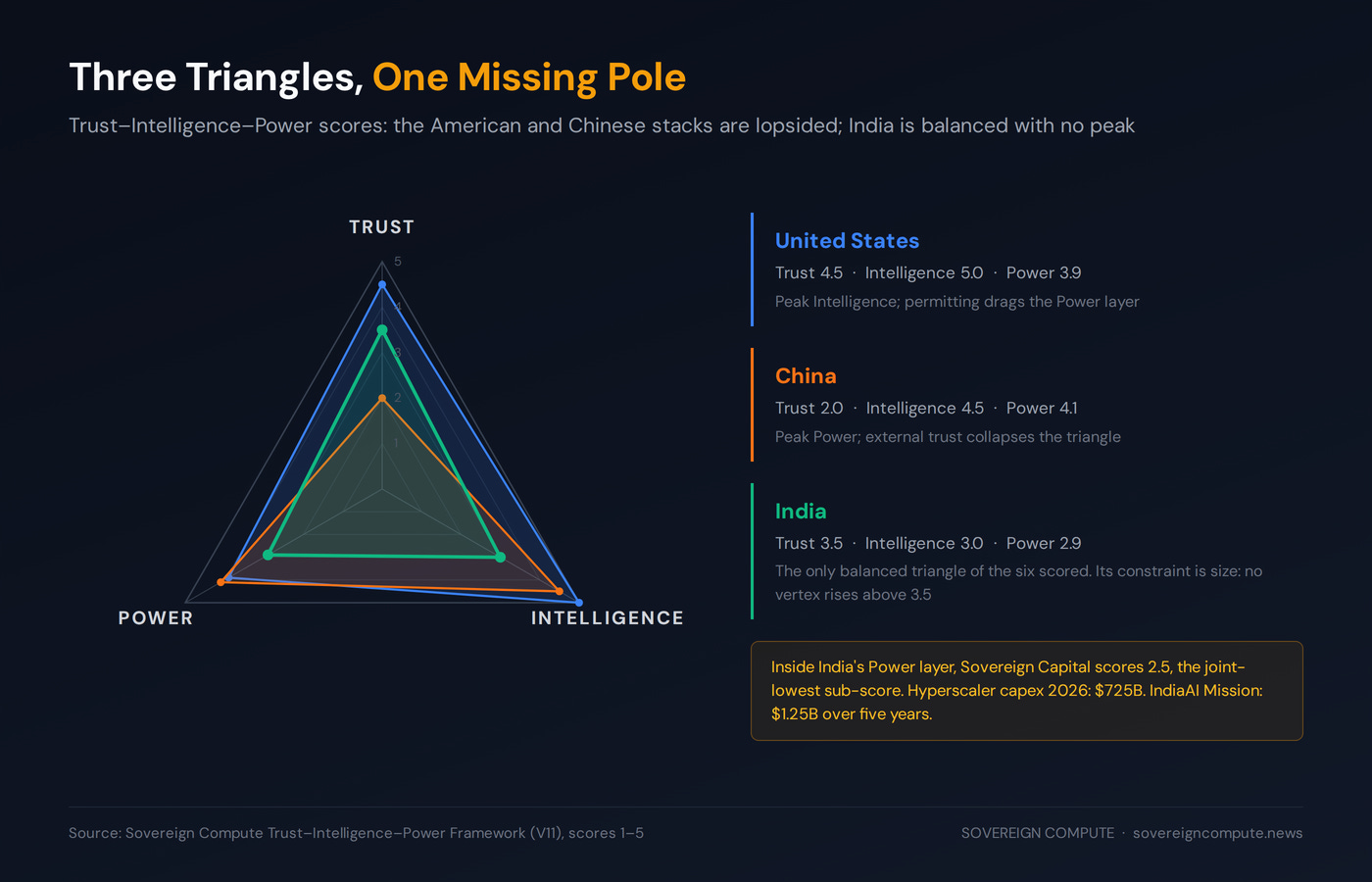
Run India through the Trust-Intelligence-Power (TIP) scoring framework and the problem becomes precise. Of the six jurisdictions the framework scores, India is the only one without a structural asymmetry. Its problem instead is size. None of the three vertices rises above the 3.5 score. Every other AI pole has one weakness to fix; India has the whole triangle to grow, and growth requires the two inputs the USA-China duopoly poles gatekeep.
The first input is capital.
Four US hyperscalers plan roughly $725 billion in capital expenditure for 2026, and analysts project the total crosses $1 trillion in 2027. The IndiaAI Mission’s budget is $1.25 billion over five years. Sovereign Capital is India’s weakest Power sub-score at 2.5, and no domestic pool closes a gap of that width while each model generation demands more compute than the last.
The second input is compute.
Access to it is political. India faces no chip restrictions today, but that access rests on goodwill, with no binding commitment behind it. The record shows how goodwill gets priced. Washington’s tariffs on Indian goods reached 50 percent in 2025 over discounted Russian crude purchases, the highest rate among major US partners. The February 2026 deal cut them to 18 percent, reportedly in exchange for India winding down those purchases. The relief was paid for partly in barrels of foreign-policy autonomy.
The TIP framework prices the bind. India’s Trust score of 3.5 sits below the American and European 4.5 because non-alignment buys independence from both blocs but costs alignment credit with each. The property that makes a third pole worth building, an AI stack answering to neither Washington nor Beijing, is the property that starves it of inputs. The TIP stress tests say the same thing numerically. A tightening of export controls hits India’s Intelligence score harder than Europe’s, because Indian AI depends on American model and chip access. At the same time, in the redistribution scenarios, where hyperscaler capital diversifies away from concentrated hubs to reduce risk, India is the single largest beneficiary. In other words, India is the highest-beta jurisdiction to any crack in the duopoly, in both directions.
The problem is, India will not outspend anyone. Its potential route is capability per dollar: the efficiency path DeepSeek and Z.ai proved viable, domestic and pooled compute that waits on no license, open weights no directive can recall. What decides the outcome is capital that does not demand alignment as its entry price: Indian conglomerates, global investors backing applied and open AI, and Gulf co-investment structured as a partnership of equals. If India secures those inputs during the buildout, the 2030s get a third pole. If it does not, expect sovereignty to fragment downward, with dozens of states downloading open weights (mostly Chinese) and training them locally, buying through decentralization the resilience a third pole would have provided through scale.
Sources
Tom’s Hardware (FT compilation): hyperscaler capex plans reach $725 billion in 2026 – https://www.tomshardware.com/tech-industry/big-tech/big-techs-ai-spending-plans-reach-725-billion
Yahoo Finance / Goldman Sachs: hyperscaler capex trajectory toward $1 trillion in 2027 – https://finance.yahoo.com/sectors/technology/article/meta-microsoft-amazon-and-alphabet-are-about-to-spend-a-shocking-amount-of-money-to-dominate-the-ai-era-115359575.html
Press Information Bureau: IndiaAI Mission, Rs 10,372 crore over five years – https://www.pib.gov.in/PressReleasePage.aspx?PRID=2012375
White House: United States–India Joint Statement, February 2026 – https://www.whitehouse.gov/briefings-statements/2026/02/united-states-india-joint-statement/
Al Jazeera: US tariffs on India cut from 50 percent to 18 percent – https://www.aljazeera.com/economy/2026/2/2/trump-to-slash-us-tariffs-on-india-from-50-percent-to-18-percent
Stanford HAI: Global AI Vibrancy Tool, 2025 edition – https://hai.stanford.edu/ai-index
Press Information Bureau: GSI rare earth ore resources and REPM manufacturing scheme – https://www.pib.gov.in/PressNoteDetails.aspx?NoteId=157165&ModuleId=3
Bloomberg: US drafts rules requiring approval for global AI chip shipments – https://www.bloomberg.com/news/articles/2026-03-05/us-drafts-rules-for-sweeping-power-over-nvidia-s-global-sales
Discovery Alert / Indian trade data: 93 percent of permanent magnet imports sourced from China, FY2024-25 – https://discoveryalert.com.au/rare-earth-india-china-dependence-processing-magnets-2026/
A note on independence: All opinions shared in this newsletter are my own and do not reflect the views of dmg events, ADIPEC, or any affiliated organizations. This is personal analysis, not institutional positioning.