
A Trillion Dollars of AI Debt, on One Fragile Assumption.
A free Chinese AI model put pressure on the one assumption holding the AI debt market together, and it matters more to bondholders than shareholders.

The AI buildout is financed on a single assumption: that running models stays a paid, high-margin business. A free, frontier-class Chinese model put that assumption under pressure this month.
For three years, the AI story was an equity story. Companies with enormous cash flows bought chips, and investors rewarded the spending. That phase is ending. The six largest US hyperscalers are on track to spend around $700 billion on capital projects in 2026, by Moody’s estimate, and their combined capex is set to cross their operating cash flow around the third quarter of this year, according to Epoch AI. When spending exceeds the cash coming in, the balance gets funded with debt. US technology issuers sold roughly $200 billion of bonds in 2025, and AI-infrastructure borrowing alone reached about $121 billion, more than four times its five-year average, with most of it raised in the final quarter. In parallel, another $120 billion of data center borrowing was moved into off-balance-sheet vehicles by Oracle, Meta, xAI, and CoreWeave. The buildout became a credit story while most coverage stayed fixed on stock prices.
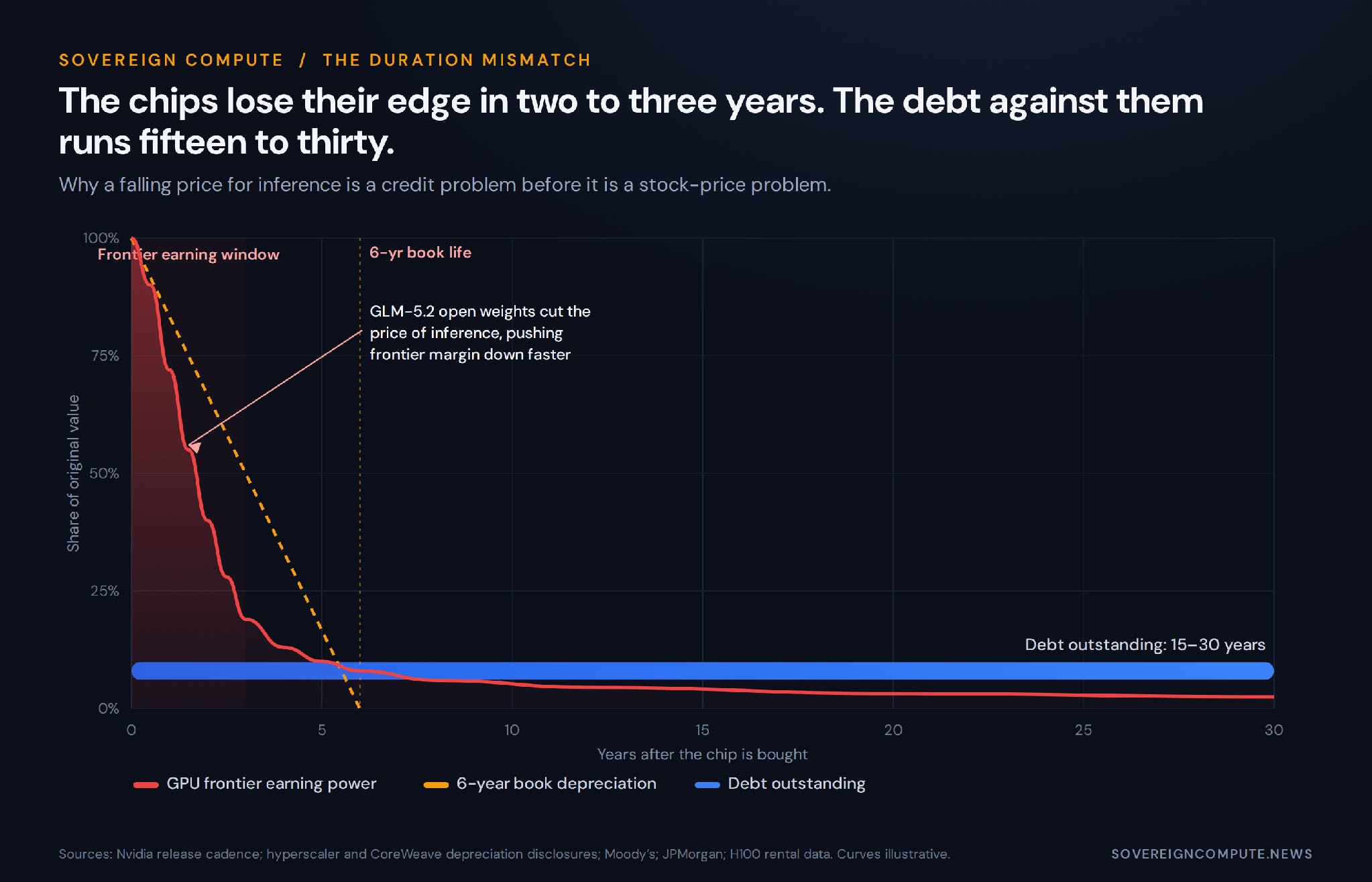
The duration mismatch: a chip’s frontier earning power collapses years before the debt raised against it matures.
Here is the mechanism that matters. The bonds and project loans behind this run long, often 15 to 30 years, matched to the 20-to-30-year life of a data center building. The chips inside that building are a different asset. Nvidia has moved toward a roughly annual release cadence, and the resale and rental value of last cycle’s hardware falls accordingly; H100 rental rates have dropped on the order of 70 to 90 percent since 2023. The hardware that secures much of this debt loses its frontier earning power in two to three years, while the debt itself sits on the books for decades.
The hyperscalers bridge that gap with an accounting choice. Amazon, Microsoft, and Alphabet have all extended the assumed useful life of their servers from three or four years to six, a change that lowers reported depreciation across the group by roughly $18 billion a year and keeps earnings, the thing that services the debt, looking healthy. Michael Burry flagged this in November, estimating $176 billion of understated depreciation across the industry through 2028 and comparing the setup to Cisco at the top of the dot-com cycle. The industry’s defense is the cascade: a chip earns its keep at the frontier for a year or two, then drops to cheaper inference, then to lighter serving work, generating revenue across all six years. Satya Nadella has been candid about the tension, saying he did not want to be stuck with four or five years of depreciation on a single generation.
That defense rests on inference staying a paid business as the chip ages. This is where GLM-5.2 enters as a financial event rather than a technical one. Z.ai released it on June 16 under an MIT license (a very permissive software license originating at the Massachusetts Institute of Technology (MIT) in the late 1980s that puts few restrictions on reuse and has high license compatibility), frontier-class on long-horizon coding work, priced through providers at around $4.40 per million output tokens against $25 for Claude Opus 4.8, which is now comparable in output.
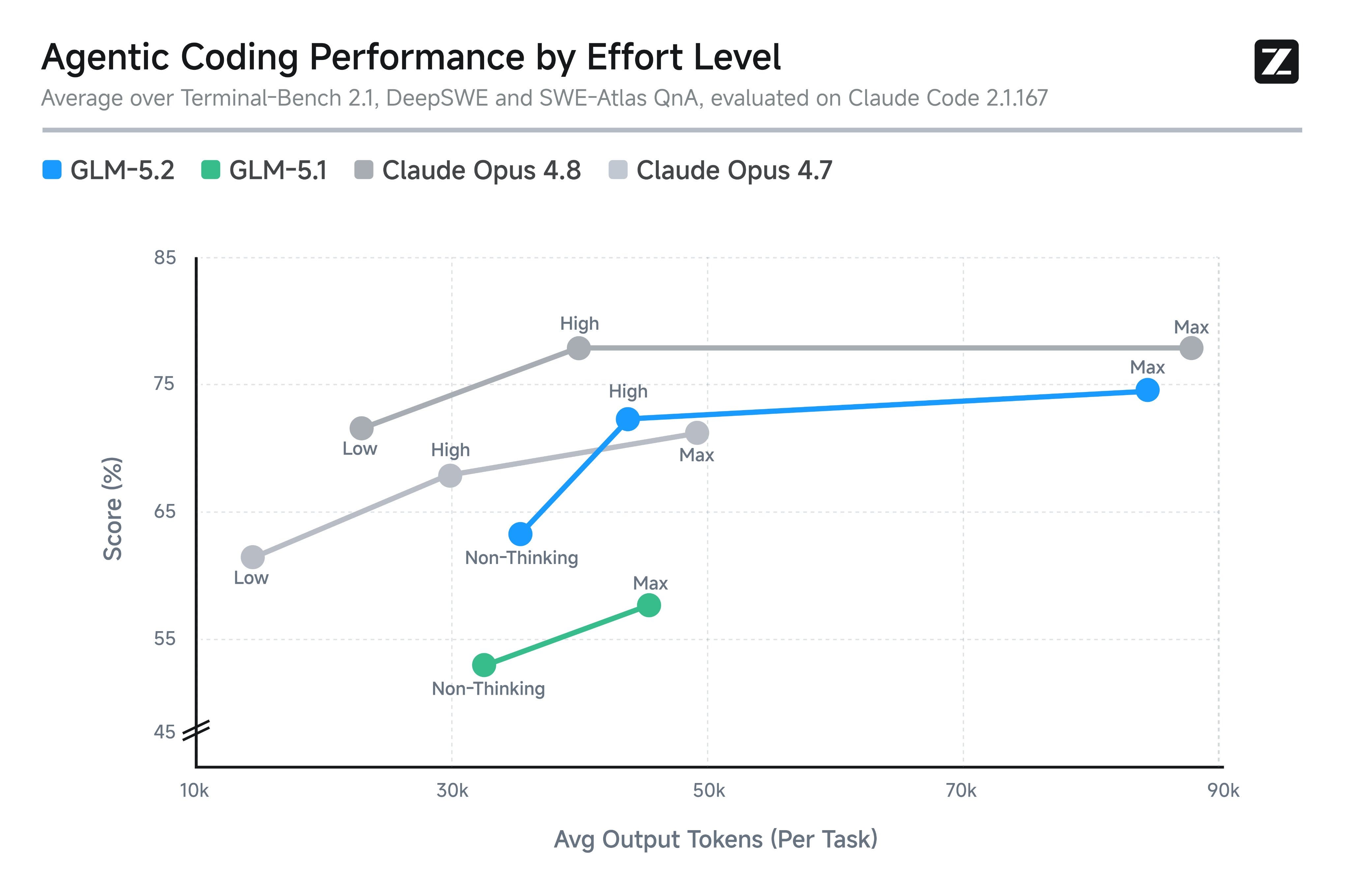
A capable open model that anyone can run compresses the price of exactly the inference that is supposed to fill years two through six of a GPU’s life and repay the loans raised against it. The cascade still works mechanically: the chip can still do the work, but it is the margin on that work that comes under pressure, and the margin is what services the debt.
So the open-weight release reads as a credit event before it reads as a competitive one. It does not touch the equity first. Free cash flow at Microsoft or Google is large enough that the stock can hold even as a non-cash depreciation argument plays out, which is why the share price is the wrong gauge. The pressure shows up in credit. Issuer spreads for the most exposed names widened through late 2025 and into 2026, with Oracle and Meta the clearest cases, and Oracle now faces a bondholder lawsuit tied to its buildout. It shows up faster in the collateral. CoreWeave pioneered borrowing against GPUs, pledging the chips and the customer contracts as security; its debt has grown past $21 billion, and one earlier facility began repayment in January at around 11 percent as the collateral’s market value was falling.
Two protections sit behind this debt, and a falling price for inference weakens both at once. The first is the hardware pledged as collateral. If a borrower defaults, the lender can seize the GPUs and sell them, but the resale market for used data-center GPUs is thin, and prices slide as each new Nvidia generation ships, so the amount actually recovered is uncertain and shrinking. The second is the customer contract. Much of this borrowing is repaid through take-or-pay agreements, the same structure that underpins gas pipelines and LNG terminals: in this case, a large customer commits to pay for a fixed block of compute whether or not it uses it. Because the payment is contractual, the lender is in effect underwriting the customer’s promise to pay, and the chips serve as a backstop. Rating agencies have followed that logic, grading these deals on the strength of the hyperscaler standing behind the contract. A cheaper, capable open model puts pressure on both protections together. When the same capacity can be served for a fraction of the price, an above-market commitment becomes harder to honor, and the collateral securing it is worth less in the very moment the contract is tested.
For an investor or a lender, the watch list follows directly: Track the spread between the most AI-exposed issuers and the investment-grade index, not the equity. Track the GPU-collateralized securitizations that JPMorgan expects to reach $30 to $40 billion a year. Track the health of the take-or-pay anchors, OpenAI’s commitments to Oracle and CoreWeave chief among them. The buildout was underwritten on the belief that producing intelligence would stay expensive. A lab in Beijing has begun testing whether that belief survives, and the answer will print in credit before it prints in any stock.
There is also a larger question sitting behind this one. When intelligence becomes close to free and AI-embedded robots take over much of the work, money stops being a claim on human labor and becomes a claim on the two things still worth rationing, energy and compute. That shift likely runs in two phases, and what happens to money is hard to call in both. In the first, energy and compute are still scarce, and they become the anchor that human labor used to be. In the second, energy and compute stop being scarce at all, and the question turns to what money is a claim on when almost nothing is rationed. The second phase is the harder one to foresee, and it is where the meaning of money comes loose. I may take this up in a future piece.
This newsletter represents my personal analysis and does not reflect the views of any organization with which I am affiliated.
Sources
Hyperscaler 2026 capex (~$700B, Moody’s) and GPU-securitization outlook (JPMorgan). https://www.theaiconsultingnetwork.com/blog/ai-data-center-gpu-debt-financing-insurance-cre-investors-2026
Capex set to cross operating cash flow in Q3 2026 (Epoch AI). https://fourweekmba.com/hyperscaler-capex-exceeds-cash-flow-crossover/
2025 tech bond issuance (~$200B) and Oracle spread pressure (Barclays Private Bank). https://privatebank.barclays.com/insights/market-perspectives-february-02-2026/ai-prompts-the-big-corporate-bond-boom/
AI-infrastructure debt ~$121B and spread widening for Oracle and Meta. https://www.ainvest.com/news/ai-data-center-boom-structural-shift-corporate-debt-credit-markets-2602/
~$120B of off-balance-sheet SPV financing (Meta Hyperion, Oracle Abilene). https://www.cryptopolitan.com/oracle-xai-meta-coreweave-off-balance-sheet/
GPU useful-life extension to six years, Burry’s $176B estimate, and the Nadella remark (CNBC). https://www.cnbc.com/2025/11/14/ai-gpu-depreciation-coreweave-nvidia-michael-burry.html
GPU-collateralized lending and CoreWeave’s debt structure (Quartz). https://qz.com/gpu-collateralized-debt-ai-neocloud-coreweave-financing-risks-050526
AI data-center financing structures and collateral-valuation risk (Quinn Emanuel). https://www.quinnemanuel.com/the-firm/publications/client-alert-emerging-litigation-risks-in-financing-ai-data-centers-boom/
Oracle sued by bondholders over losses tied to the AI buildout (Reuters). https://www.reuters.com/legal/oracle-sued-by-bondholders-over-losses-tied-ai-buildout-2026-01-14/
GLM-5.2 open weights, MIT license, and pricing (Z.ai). https://z.ai/blog/glm-5.2
Oleg Kofanov wrote:
Ivan, sharp analysis — the duration mismatch between debt tenure and chip earning power is rarely framed this cleanly.
One hypothesis worth adding: the bet may not be on inference margin at all — it's on controlling energy infrastructure. A 30-year data center is land, power capacity, and grid interconnection. The chips rotate. The building doesn't.
Jevons also hasn't been repealed. If inference drops 10x in cost, demand could grow 100x in volume. Cloud economics already ran that script.
The debt may not be justified by today's model economics — but by a calculated bet that the rules of the game change before the bills come due.